Thursday, January 25, 2007

São Paulo to Puerto Iguazú: 'Puedo usar el internet?'

8th February 2007, Day 329

Buenos Aires, Argentina

It's almost time to close the book. If this blog existed in a physical form, banging in my bag for the last 11 months, it would now be dog-earred, blotched with spilt beer and barely ledgible. God bless the megs (the internet for those who don't understand this term of affection). This blog, and the internet in general have made correspondence piece of cake for travellers. Cheap, widely available, and instant communication now exists which makes today's travellers completely unaware of the isolation intrepid itinerants used to experience. Indeed communication is the theme of this entry. We have another three weeks before we cross the Atlantic that has made me an alien of me these past fours months. During our way down from Rio we've passed through some sharply contrasting environments - cities, jungle and tranquil coast - and we've now crossed the border into Argentina, brushing the Paraguayan border on our way. Throughout this heady stretch, our last piece of serious travelling, I lost my muse, found it again and now have spare time to work on my paranoia about going home.

I expect that these final months of our junket will stain my memory as an ongoing battle to express myself and understand others; we arrived in Chile and learnt some Spanish which was fine for travelling in Perú around the backpaker route up until Christmas. We knew things would change in the New Year. Once we got past NYE in Brazil, the plans we made back in England petered out. I don't think we seriously thought we'd make it this far, so unexpectedly we had two months left to our own devices. Faced with this unforeseen dividend James and I have been left to pursue our own hastily arranged agendas. Our ambitions have lead to a need for more sophisticated conversation with the people around us in order to get by minus tourist infrastructure. At times we have needed to say things as complicated as 'Is there an internet cafe near here with PC's that have functioning USB ports?! One with a computer that doesn't have a locked desktop, needless restrictions and that is useless in every practical sense?' Tough going.

I include the photo above to illustrate our struggle with Portuguese while we were in São Paulo. Here our friend and resident Paulista (somebody from São Paulo state), Fernando, is helping James with a menu in Portuguese. We would have stood no chance in such an fast moving city like São Paulo without him.

As soon as we arrived in Rio it became apparent that we were going to struggle with the Portuguese language somewhat. We found a restuarant and realised that we didn't understand much on the menu and that we'd need to learn a set of nouns afresh. We never got on applied ourselves. I had to eat a lot of rice with broccolli.

On trying to read and pronounce the language, which sounds like fusion of French and Spanish, we realised what a tough proposition picking up this language would be after just starting to learn Spanish. Our enthusiam waned and I think somewhere in our post-plan impotence we lost the will to give the language a stab. As we'd paid for lessons and made some headway with this new tongue we were reluctant to obscure and confuse our latin American Spanish with latin American Portuguese. I now this would have happened: just as it took me several days to stop saying gracias in Brazil, it took me just as long to leave obrigado and muito bom behind once we got into Argentina. Little phrases do jump around in your memory when you've never learnt a language to a competant standard before.

We received a comeuppance for our laziness, don't you worry. When we weren't being 'babysat' by our friends/nannies - Lia (in Rio) or Fernando (São Paulo) - we sunk to a level of verbal isolation thus far unknown. The places we visited in Asia, except perhaps Japan, always had a number of ready English speakers or English translations/signs. No problem. Even excluding the Spanish we could speak, we'd stuck to the backpacker beaten track elsewhere in South America so we didn't encounter many difficulties as we could always do the very basics with ease. By contract it got to the stage that when people spoke to me in Portuguese, it might have well have been Martian. We stuck to Hostel International chain (the Youth Hostel Association in the UK) and closely to friends and aquaintances to weasel our way through the four weeks. Comportamento terrível!


A view of São Paulo from the very pleasant Ibirapuera park. This is a misleading photo. Most Paulistanos would readily admit that their city is not picturesque - it's not exactly ugly, but it has very few parks and not much green space to speak of. One consequence of all the asphalt, which the plentiful exhaust cannot escape, is the air pollution which gave me a throat infection. More of that in a moment.

After being around Rio de Janeiro during the beginning of the tourist season, I'd be lying to say we weren't relieved to make an uneventful journey across to the state border and into São Paulo. Rio is infamous as one of the most dangerous cities in the world and this added to some circumstancial events made me feel less safe than any other city or country we visited: a tourist bus, taking the same route as us, was the target of some of the Favela gangs. They were trying to punish the incoming Rio de Janeiro state governor who had pledged to crack down on gang related crime. This particular bus was set on fire and seven tourists were killed. São Paulo didn't exactly feel free and easy to me, but it was a relief after the oppressive atmosphere of Rio.

When we arrived at São Paulo rodoviária, we had arranged to meet another friend from the internet music forum through which we'd met Iain in Japan and Roberto in Chile. Bowlie (the forum I mention) has come up trumps three times in a row now! An extremely friendly and chatty Fernando Brito bounded up to meet us, grinned, shook our hands and the conversation never stopped from that moment on. He's the sort of person I can't imagine being down. Fernando took us to the rather dingy hostel we'd booked, rang up the staff when we found that the door was locked, checked out the hostel, waited for us while we had a shower and then offered to put us up in his own house at zero notice!

A quick aside. I still find it hard to believe generosity, amiability and kindness of most people we've met. We have certainly accrued a debt of hospitality to pay off.

Back to the issue of discourse. Fernando was slightly uncertain about his seamless English when he met us, because he is used to writing and not speaking it. In fact within one evening of meeting us he'd spoken more English than he had during any other single occasion in his life. All of Fernando's friends seem to speak at least one language fluently. The scores are even between Fernando and his girlfriend Dani:

Fernando - speaks perfect Spanish and English.
Dani - speaks perfect French and Spanish.

I take my hat off to them both. Our response to this was to speak English to Fernando and to get him and his mates to help us out with our day to day life. Fernando even leant us his old mobile phone so that we could be in close contact with him for the two weeks we spent in São Paulo. When our new friends weren't about we found ourselves out on a limb.

One of the occasions when we got most frustrated by the language barrier was in our first hostel in São Paulo. The hostel manager spoke enough English for us to get by, but was rarely present and relied on the cleaner to sort out her affairs. The cleaner persisted in speaking Portuguese to us long after it was established that we understood nothing of the language. This caused a misunderstanding about payment which infuriated James. A simple misunderstanding because the cleaner would speak to the manager (the person who spoke some English) on the phone and then hang up and then tell us what she'd discussed with the manager in Portuguese. As I was ill, James was having to arrange this himself and not having much joy, but eventually I got up and we sorted it out between us by forcing the cleaner to let us speak directly to the hotel manager. There was some irrationality on their part, but if you visit a country without speaking the language this is the kind of scenario that crops up.

It's time to talk a little about what São Paulo is known for: it's nightlife. We didn't expect to spend a fortnight in Sampa, but we also hadn't reckoned upon meeting people like Fernando and his friends who went out of their way to include us in their social life. Indeed we'd only been in the place for four hours before we found ourselves at a full-on house party with plenty of Fernando's friends and others. It was great, those people really made an effort to speak to us even if they couldn't speak much English. The party was on and we felt right at home. I've never been in such erudite company, the place was full of journalist and lawyers. By the end of the night I'd ended up in a club called Vegas and left at 12pm, Sunday lunchtime! I spent about two hours in the club asleep, but I enjoyed myself before this from what I can remember... It's a good job there was someone to look after me and wake me up. On another occasion we went to a club called D-Edge, which is the first time I've been to a worthy electronica club for several years. I enjoyed the progressive house more than I expected. A good experience.
The main thing I noticed about clubs in Sao Paulo was the lack of attitude pervading those places. There were no 'big time charlies' knocking into you deliberately or the threat of violence hanging in the air. Like Rio, people were out to have fun.

After the dance music, we went to Funhouse, an indie club created from an old house. We always feel at home in an indie club, and this was no exception. I especially enjoyed hearing 'About You' by Teenage Fanclub so far from the British Isles. For more information, Fernando writes about this club on his aide to São Paulo on the Indie Travel Guide, a website for those who like a certain type of music travelling in cities all over the world. Yours truly co-authored the Reading section on this website.


I underwent only my third bout of illness in São Paulo since I'd been travelling, which I imagine is good going. On our third day in town I started to feel unusually tired. I spent the night with a painfully sore throat and had no energy the following day. James did his best to look after me and got me medication and supplies. After the bout of weakness passed I thought the episode was coming to a close. It took several days and a change of hostel before I woke up with enough of a sore throat to prompt a visit to the doctors. I tried to go the following day but had no idea were to start. The casualty ward just wasn't an appropriate place for me to queue up with serious sick people and then push forward the piece of paper I had with 'please could I see a an English speaking doctor', scrawled on it by the HI hostel staff. Fernando's friend Léo came to rescue the following day and accompanied me to the hospital translating on my behalf. It turned out that I had an adenoidal infection and got put on a course of antibiotics. I don't know how I would have got medical attention without Portuguese speakers around to help me.

A quick word about the Brazilian public health care system. Everybody told me I'd be waiting for hours to be seen and diagnosed. I was in and out of the clinic in under half an hour, with no appointment. I was extremely impressed.


Cup o' beans, anyone? Frequent were the conversations I had with people about how tough I might find it to be a vegetarian outside of Europe. Well, I can tell you it's really not hard at all based on my experiences in Asia, Oceania and South America. The exception to the rule is Brazil. They tend to mix meat in with everything including this cup of Carioquinha beans which Fernando thought was vegetarian. I left it for the birds. More arroz con brocolis for me.


Our ears and tongue in Sampa. Fernando (on the left) and Bili showing us how to let one's hair down in São Paulo. To Fernando, Dani, Bili (Marcello) and Leó, thank you so much for your kindness. They showed us around the nightspots, but also markets, the sights of the city, restaurants and hospitals.

This was the evening before we left Sampa. We must have spent 50 reais in the juke box that evening and our high spirits ended in some extremely silly photos of us. We posed on the small stage at the back of the pub which had a gaudy gold drape and looked like something out of New Orleans bawdy house. It was a appropriate way to say goodbye to this hard working, hard partying city.


Sunburnt feet, Florianópolis. As we planned to get down to Buenos Aires by the 1st February we didn't have much of January left by the time we'd dragged ourselves out of São Paulo. We wanted to enjoy some beach time with one eye on the of the freezing British March that awaits us, and with that in mind we stopped off in Florianópolis before heading to Iguazú falls. We managed two days on the beach and ended up more sunburnt than anywhere since Ko Phi Phi in the Indian Ocean.

It was nice to get to Florianópolis. Another city but not one nearly as imposing as Rio or São Paulo. Ilha Santa Catarina on which half of the city lies is a middle class tourist resort for Brazilians, Argentinians and Uruguayans. Therefore it's pretty safe, and I was glad to let my guard down a bit regardless of whether the threat we'd faced in Rio and Sampa was real or imagined. Santa Catarina has numerous beaches facing into the Atlantic which are beautiful but which have some fierce coastal currents. We visited Ingleses beach (developed with lots of unidentifyable oddities washed up on the beach) and Joaquina beach (plenty of beautiful people). At the latter we considered doing some surfing and planned to spend a full day in sun. We couldn't hire surf boards, so after a bit of splashing about in the sea we spent a long time in the blazing sun trying to find the bus stop. We ended up with the sunburn you can see above. Calamine lotion doesn't help to soothe the exposed area much, but it does turn red skin a purpley shade of pink!

One thing I noted about Santa Catarina was it's network of buses, which were well organised and operated around a number of different terminuses based in the geological extremes of each part of the island. We got around pretty easily, and saw plenty of the rest of the island out of the bus window. In retrospect it was shame we got burnt, because of the huge lake in the middle of island looked ideal for swimming and other watersports.


A view from the edge of Ilha Santa Catarina. This part of the island is also the eastern side of Florianópolis. It looks a little like Rio because of the islands in the distance and the coast-hugging avenue which is packed full of condominiums and apartments overlooking the bay between the island and the mainland. There was even somewhere for me to go running; a purpose built track following the avenue which had distance markers along it's length. Very nice.

I think the folk in the photo were doing a type of yoga in the late evening sun. The photo has lost the sense of that brightness. I took the picture as it seemed to represent the kind of trendy civic leisure ideal that city tourist boards are always trying to capture. Florianópolis was that kind of place: designers malls, posh restaurants and well dressed sophisticated residents. Pretty souless, really.


Mighty Iguazú! No translation was necessary for us to understand the elegance of these waterfalls. The roar of the waterfall is inescapable when you arrive at the parks. We took the time to see the falls from both the Brazilian and Argentinian sides as they stretch for over a mile and half.

This is the centre peice of the falls: the Devil's Throat. It's a U-shaped 150-metre-wide and 700-metre-long (490 by 2300 feet) cliff which marks the border between Brazil and Argentina. You cannot get a view like this of a waterfall anywhere else on earth. Depending on your mood it is a thunderous testament to infinity or brush with the apocalypse.


This is view from beneath the falls on the Argentinian side. The mist gives you an idea of the power of this natural phenomenon.

Iguazú attracts thousands upon thousands of visitors every year, and there are some excellent hostels in the vicinity to cope with the demand. The second of these places was a great resort type place in Puerto Iguazú (Argentina), with swimming pool and large restaurant. It gave us a short time to pick up the Spanish studies again and some people (the staff) to practise on.

As soon as we'd crossed back into Spanish speaking territory we were relieved to be able to do simple conversational things like order food in restaurants politely (having understood the menu) and buy tickets, book into hostels. I had at least ten verbs to call on for communication! Exactly ten more than I had in Brazil.


What wildlife lurks! This kamen hangs silently in the calm waters above Iguazú. Waiting to pounce no doubt. If only the baby croc had been near enough to get a snap at the idiots who were throwing bread at him.

The other commonly sighted animal around Iguazú is the Coati, which is from the Raccoon family. They are known for being dexterous and inquisitive towards to humans. When a pack of them approached me they seemed a little like dogs and climbed the bottom of my leg to have a good gander at me. Whilst I tried to take a photo of one he spied my open rucksack on the ground and in one deft movement pulled out the sandwich I'd just bought, teared open the cellophane wrapper and gorged on the (disappointingly for the Coati) vegetarian contents. I should have learnt my lesson over this since that deer ate my banana in Nara, Japan.


A particularly attractive butterfly above the Devil's Throat. I've never seen so many before, I think my Grandfather would have loved to been there to see them. I have done a quick search on the internet but, I can't find out what this particular type is.

It was a delight to see such colourful and exotic wildlife in detail. I forget how much of a thrill it gives me.


Travelling in luxury. This is the 'full cama' bus we travelled on from Puerto Iguazú to Buenos Aires. The shot doesn't really capture how much space there was on this bus, which was what I'd intended. You could literally drop the back back of the seat to a vertical position and pull up a foot rest so you had a proper bed. You wouldn't anticipate that a 17 hour bus ride could be this comfortable, or even enjoyable. The total journey from Puerto Iguazú to Buenos Aires cost 32 quid. Not bad for a 1234 kilometer journey including dinner, breakfast and free alcohol.

As I say, we are now back in a Spanish speaking country and we have spent much of our spare time redoubling our efforts to learn the language again. We have an obligation to at the moment: we are working with a children's charity called LIFE. Speaking Spanish is our only way of making exchanges I will cover this in my final post from Buenos Aires!

A last word. Since we arrived in Buenos Aires and started I've met many individuals who are staying in Argentina for three months in order to intensively study Spanish and it seems a great idea. Having met Roberta, a Swiss girl, who seems to have good conversational quality Spanish which she learnt in three months in Costa Rica, it seems to work. I must admit that I did feel a sense of regret that we didn't think of this before ourselves. We might have planned to learn Spanish in a formal sense over the last four months. This would mean we wouldn't have to stand around in dumb ineptitude while Spanish speakers try in vain to communicate with us. It'd be great to do something like this in the future. Our money is spent now!

Tuesday, January 02, 2007

The end of a different year

14th January 2007, Day 303

São Paulo, Brazil

That's the first time this year. I have just typed the date at the top of the page and put '2006' rather than '2007'.

I'm alarmed that last year is sewn up in a box and placed on the shelf. I can pick it up for handy anecdotes at any point I suppose, but it was supposed to be a tool box of experiences rather than an ornament.

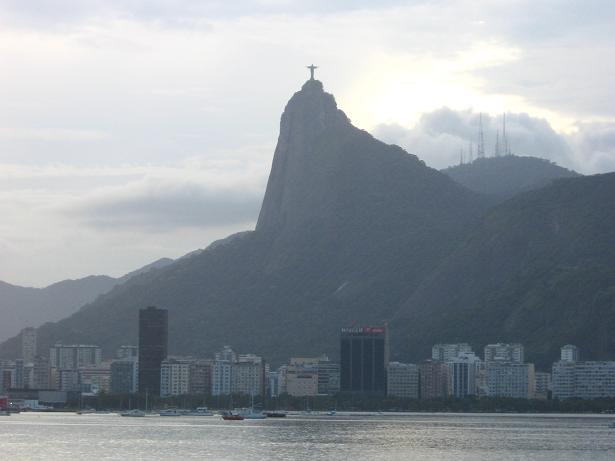
We've been travelling for almost ten months now, and our own lent has arrived and a more frugal and disciplined attitude is unavoidable. Or perhaps debt is unavoidable. This is rather appropriate in a Catholic country, don't you think? There is no need for a retrospective piece about last year just yet, let me tell you instead about the rather indulgent way we celebrated last year in our very own carnaval - like Shrove Tuesday, but with fewer eggs. I'd also like to add a few small observations on the difference between how the yuletide period is enjoyed in Latin America (or at least Chile and Brazil - note the picture of Rio's Corcovado above) and some my thoughts on social convention here.

In the UK, I think people suspect that Latin American Christians are more devout or serious than in north-western Europe. Certainly I expected there to be much more regular church going and rather more solemnity at Christmas. I don't know if that's true based on the opinions of the South Americans with whom I've spoken. At home, I believe people are resigned to a Yuletide with pieces on the news about retail profits and grottos in department stores. I was somewhat correct Xmas here had a little less of that, but from what I could tell in Chile and Brazil, it was more low-key than pious. Christmas in the British sense, did not begin until mid-November. Good Lord! I thought preparations started in August in Woolworths. While were in Perú - and especially Cusco - the usual Christmas tat familiar from home appeared, when I heard some Spanish carols being piped into a supermarket in Nasca. Later, in touristy Qosco we came across plenty of decorations, but in general it was escapable.

For the first time I was not with the family for Christmas day, but in Catholic Chile. I felt it was better not to mention my main contact with Catholics in England, is symbolically burning an effigy of one every November in my Grandparents's back garden.

We amused ourselves in our own way over the Christmas period. We had hoped that when we arrived back at the Bellavista Hostel in Santiago, which we liked so much when we'd been in Chile the first time around, the owners would have something organised for Christmas day. Sadly the hostel cleared out somewhat over this period, so we were left to our own devices (although we were fortunate enough to have our friend Roberto to hang out with). We were in a quandry of sorts, but we are never truly bored when there is internet available.

To amuse ourselves for a week in Chile without going blind (I mean damaging our eyes with computer monitors...) we bought some cheap guitars. This, by James' reckoning, was the best decision we'd made in the last 10 months. Pretty soon we were downloading guitar tablature and knocking out semi-competent cover versions of popular songs. Perhaps the only thing which caught our attention in a sleepy Santiago was Colo Colo (a Santiago football team) winning the national league and their supporters going nuts at Banquedano station. The Chilean championship was a consolation for Colo Colo fans after narrowly losing the Copa Libertadores da América, America's version of the European Cup, a mere two weeks earlier. When ever something of national significance happens and people gather in Chile, it's at Banquedano, much like Trafalgar Square in England. Only a couple of weeks earlier people met to celebrate Pinochet's death there. This was fortunately an occasion much less complicated in emotion.

Whilst on the topic of Pinochet, despite his death and the resulting fury or clebration or mourning, it was dead calm. Visiting the country directly before and after such an ostensibly significant national event, there was no clear change in the mood of the place that I could pick up on.

On Christmas Day itself we decided to jettison the traditional Christmas day altogether. We had a day without a roast dinner, presents (well at least James did, he bought me a guitar chord book - obviously a well brought up boy), Christmas specials, the family Christmas Day constitutional, cold weather or my dog dressed up in a silly new coat.
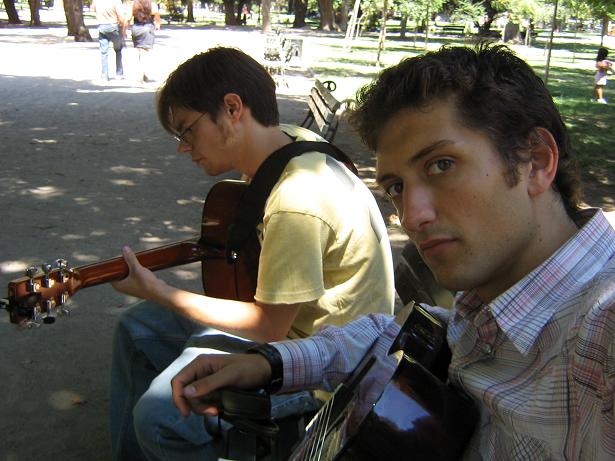
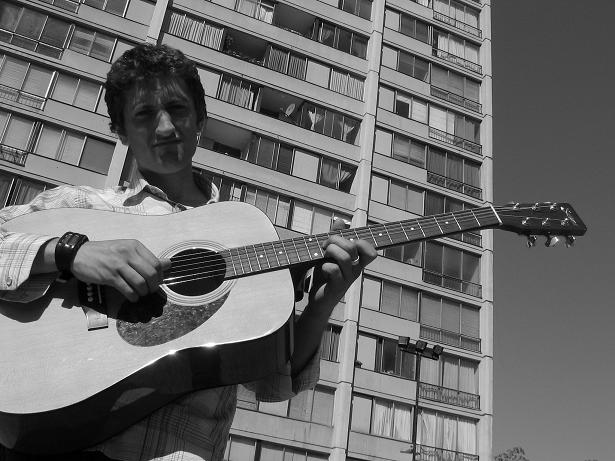
Instead we used our imagination. We sat in sunny Parque Forestral in central Santiago, played guitar and drank beer. Only later after he'd seen the photos did Roberto inform me that drinking in public parks was a criminal offence in Chile. During the day, which was passed in an alcoholic fug, we managed an impromtu photo shoot next to the Unimarc supermarket. One or two people reckon I look a bit like the front of an early Dylan LP in this picture. What a compliment! James has a similar arty shot on his equivalent blog entry. Of course,
I was not vain enough to put mine at the top of the post ;-)

What is of more interest is not what we did, but what the Santiago residents were up to that day. There were lots of people about in the park, mainly people engaged in their own post gluttony amble, but also loads of kids in the swimwear dancing about in the fountain; it was beautifully sunny. I think we slotted in very well in an unconstrained atmosphere and we were a novelty of sorts to the kids. The energy levels were probably higher in the sun than under cloud in the UK, but people were still happy doing nothing in particular. Basically nobody does much on Christmas day, case closed.

Only one wispy cloud appeared that day. A drunk guy wandered up to us with his kid in a pretty jolly mood, and asked for a beer - no problem, it's Christmas, I thought and gave him a bottle. I immediately regretted it wondering how the kid looked after himself after his Dad passed out. The were plenty of similar folk in parks and on streets all over the world, of course. That's part of the global Christmas. Just like the rest of the year.

On to other matters. We arrived in Brazil on 27th December ready to wind up for the notorious New Years's Eve celebrations on Copocabana and Ipanema beach. We met up with Nathan (one of our friends from home) who by a happy coincidence was travelling in Brazil when we arrived. We started the process of familiarising ourselves with a different South America, and one where we couldn't speak ANY of the language. Pronouncing Portuguese is a bind if you haven't many pointers, and the to and fro of everyday life has been a touch more challenging since we got here.

When I was at home preparing for this trip, I read the book A Death in Brazil by Peter Robb. The book focuses on the political climate of Brazil over the last 40 years, but he also interweaves the history of Brazil from the Portuguese landings to the present day. This was the first place that I heard about the Festa de Iemanjá, which takes place (in Rio at least) on New Year's Eve.

The Candomblé religion, of which Festa de Iemanjá is a part, was a religion belonging to African slaves who were brought to Brazil by the Portuguese from the 1500's until the 1800's when slavery was abolished. The religion itself was outlawed by the Portuguese, for being paganistic, but it persisted via clandestine ceremonies and the assimilation of some parts of Catholicism.

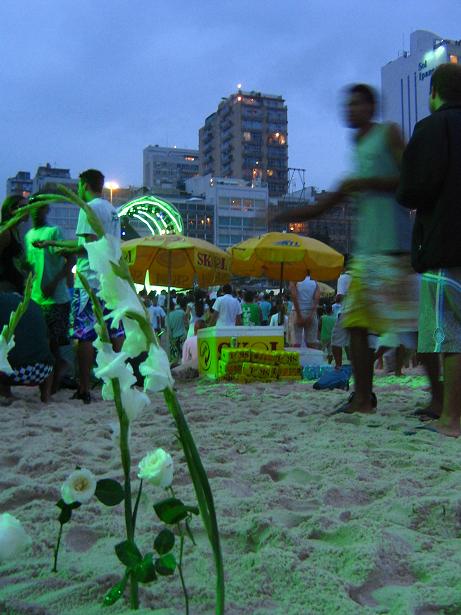
Iemanjá, herself, is Goddess of the Water and mother of all gods in Candomblé. She is also recognised as being St. Anne, patron of the sea. This double-life is something more complex than a simple rouse to throw the authorities 'off the scent': Candomblé is polytheistic and as such, not totally inflexible to absorbing other idols as Catholicism presumably might be. During the Festa de Iemanjá the Brazillians dress up in white and offer Iemanjá gifts such as lit candles, flowers and rice, cast adrift from beaches in toy boats. You can see some of these items prepared in the photo above. This is to thank the goddess for her good will over the previous year and to urge favour in the year to come. It's quite a sight.
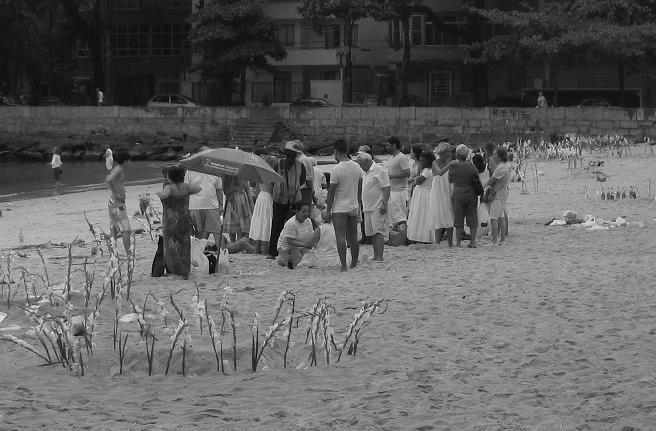
When we arrived in Rio, there were several nights of preparation for the festival, which gives you some idea of it's significance. At our hostel in Urca, on the Sugar Loaf peninsula, there was a little cove where practice for the big event at Copocabana and elsewhere was taking place.

This is a picture of the Iemanjá Festival warm up in Urca cove. James has a night shot of the same place on his blog. We walked past this everyday while we were in Rio... because it was next to the internet cafe.


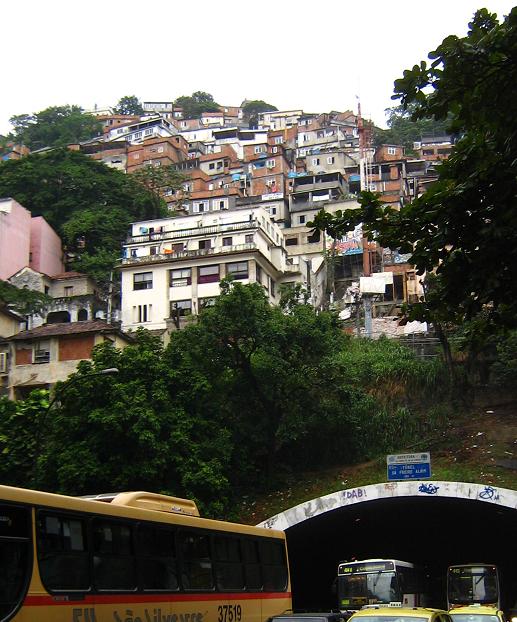
This is a favela in Copocabana. This is just a few streets back from the sea front.
Apart from being surprised at the proximity of wealth and desititution in Rio, which is well documented , yet probably surprises every tourist, I won't attempt to talk about Favela life in Rio. I just don't know anything about it and it would just be speculation. There was one party, however, that everyone could go to, even if they weren't there by invite. The beaches on New Year's Eve. My photos of that night follow.


The big lighting rigs for the DJ on Ipanema light up one of the offerings to Iemanjá.


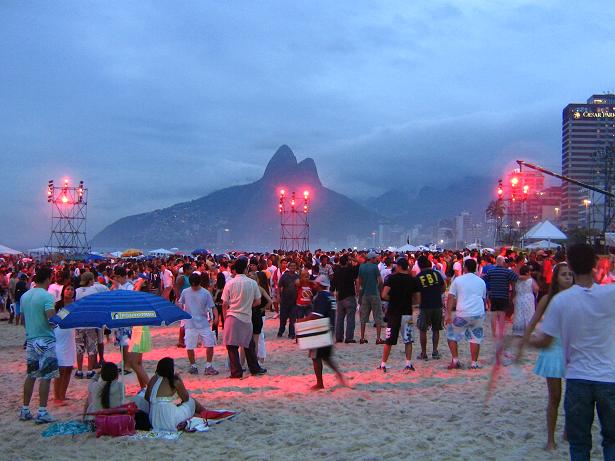
Ipanema beach. The very faint lights on the hills in the background are a favela.


This was the best firework display ever, they were actually spectacular, rather than just being described as such by the local rag in the next day's newspaper. Following the fireworks the Iemanjá celebrations began, but it took us while to fight through the throng hemming in the sea from the beach before we could see anything. And when we got there we didn't see much. It was a meleé of dancing, jostling and swimming. I didn't see many offerings being pushed out in boats, I guess the rough tide would sink them. My trainers got wet.


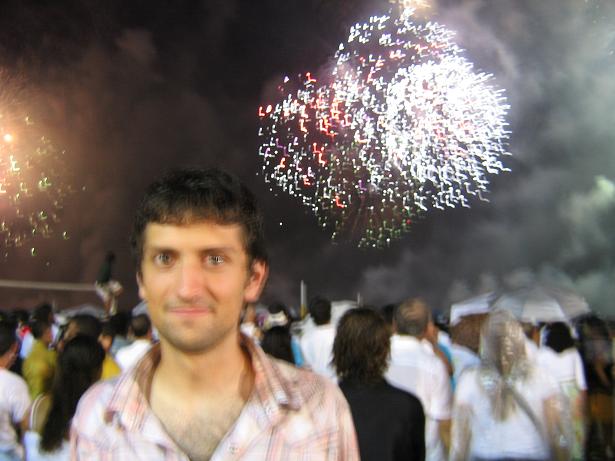
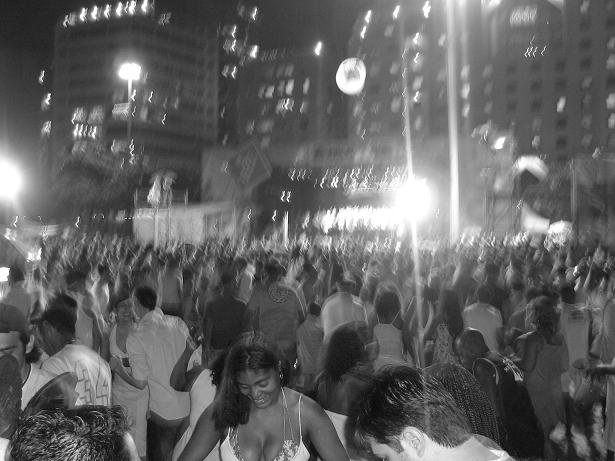
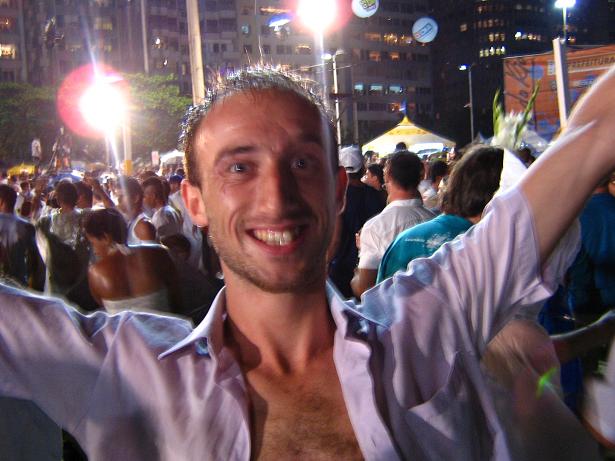
Feliz Ano Novo. This gives you an idea of the atmosphere on Copocabana at about 00:01 on 1st January every year. We were as wobbly as the photo at this time, you'd expect no less...


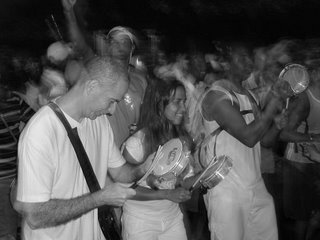
A samba band we joined in with as we moseyed down Avenida Atlantico which runs the length of Copocabana. The instrument you see being played is the Pandeiro (a bit like a tambourine) which is especially prominent in Partido alto Samba. We joined in the dancing for a while before wandering on to have our magpie gaze attracted by something else. We walked from Ipanema all the way to the Leme end of Copocabana and saw scores of street entertainers, primadonnas, exhibitionists, a great variety of food vendors, drug pushers, cops, rich, poor and plenty of awe-struck gringos.

Whilst in Brazil we went to a fair few Samba clubs to dance, which James goes into on his blog. The big issue for me was the dancing. I awkwardly manouvre in my father's footsteps at dancing. Dancing in a Samba club? No chance, I'd be laughed out. Jumping up and down in an indie disco in the UK is not really dancing when you've seen this. To dance is something different altogether, out here. Oh! To be totally unselfconscious and entranced in the music. It ain't gonna happen to me. However, it was a surprise and relief to me that the atmosphere in the samba clubs we went to, did not feel in the least bit competitive, snobby, machoistic or agressive. The people I observed were polite and there to dance, often with a partner but happy enough without. They were not in the least worried about other people, as they themselves were - as I anticipated - fantastically fleet of foot. James was rather more adept than I at Samba, but I was soon contorting myself without fear of rebuke. The Bossa Nova or Samba musicians seemed sublime to me with more esoteric percussion than I'd previously even seen. It was just different and truly, cool.

Nathan is certainly Mr. Party. He became a sort of Brazilian oracle to us while we were in Rio, as he has an interest and good knowledge of Bossa Nova as well as being a competant Bossa guitarist. Even I learnt the basic chord sequence and approximated of the rhythm of The Girl from Ipanema (inevitably I did whistle this whilst in Ipanema, but strangely nobody tried to strangle me). Nathan's generally an enthusiastic man, but his behaviour in Brazil makes me suspect he might be Rio bound permanently in the future. As I had imagined months before, he chastised me as a 'wet lettuce' for slinking off to bed at about 4am. It was pissing down with rain, sod you Nath ;-)


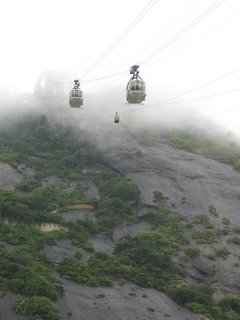
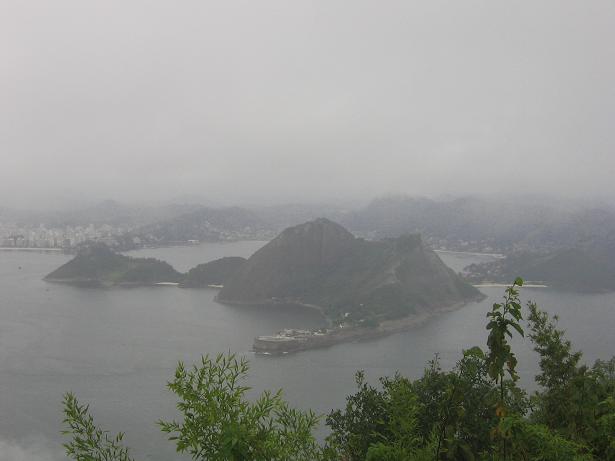
New Year hangover. Don't bother going up Sugar Loaf if it's this cloudy. Enough said.

Monday, December 18, 2006

Man down! Machu Picchu in picchures

22nd December 2006, Day 278

Qosco, Peru

A nice break for you all. This will be a quick painless affair with hardly any preaching and just pretty photos. Undo a notch of your post-Christmas lunch belt and relax. For a more detailed post check out
James' blog.

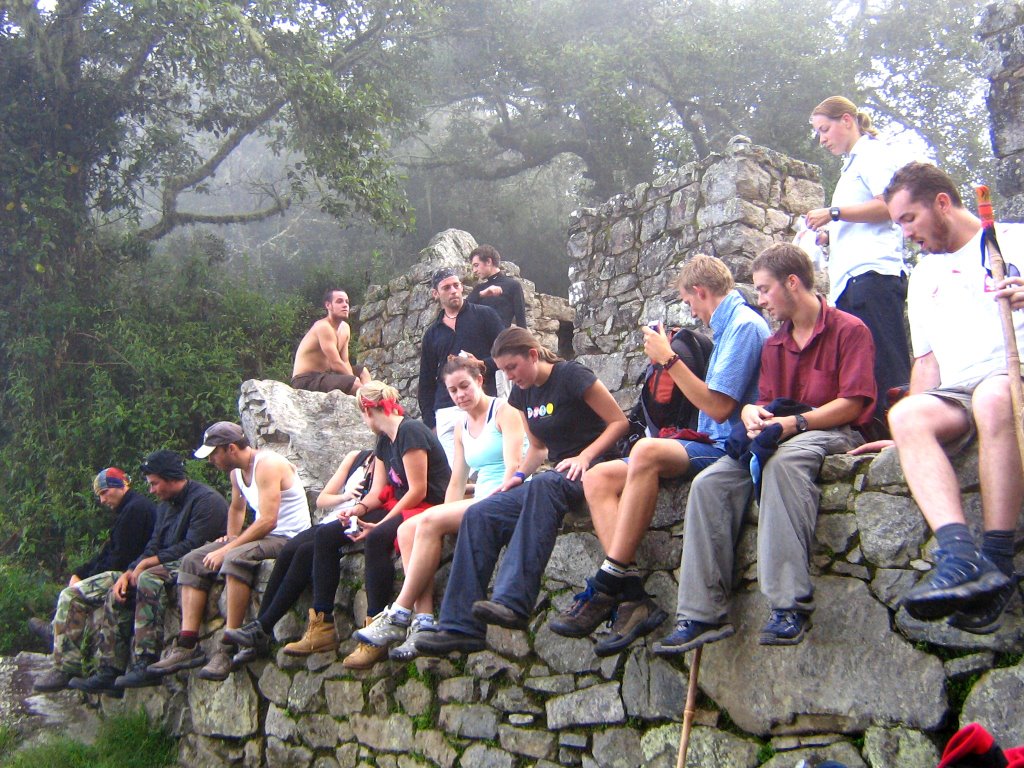
We finished the Inca Trail a few days ago. I am bored of talking about it with people in our hostel, so I'll just mention a few things that stick in my mind.


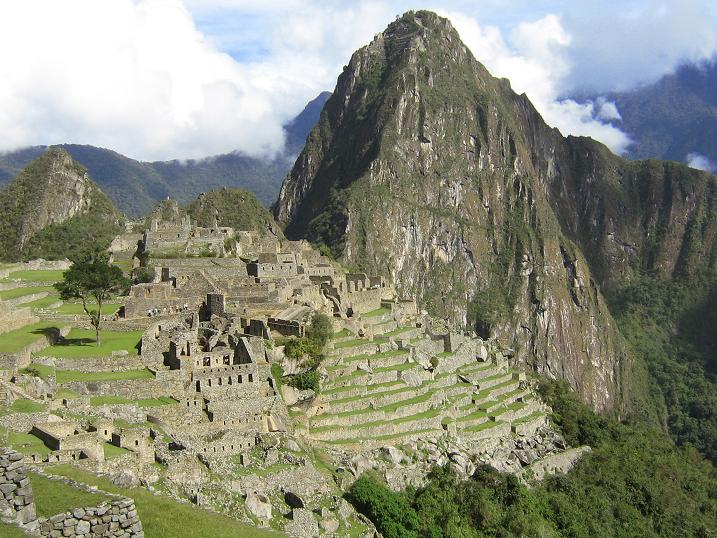
Here's Machu Picchu itself, one's reward after a four day hike. It is another of these UNESCO world heritage sites. The UN apparently take bit more interest in this than the Nasca Lines and warn the Peruvian government that even the present regulated tourism here is having a seriously denuding effect. In fact some scientists at the University of Kyoto reckon that the whole city site is slipping down the mountain at a significant rate each year. I'm glad I went because if it might not be here for much longer. When we arrived the city was totally encircled by cloud, but thankfully this passed off and we received our long awaited 'oooh' factor.

The favourite theory for Machu Picchu's purpose was that in addition to it's status as a holy place, it was an outlying retreat for the Inca and his Quechuan nobles in event of an enforced evacuation of Cusco, the capital of Quechuan empire. As it turned out an evacuation was what they had to make after losing battles to the invading Spaniards, fortunately they had a place to go to and plenty of ways to get there.


The so called 'Inca Trail', is actually one of a number of different tracks which lead to Machu Picchu, one of the only Quechuan outposts which was never discovered by the Spanish due to a campaign of disguising and hiding it with twigs. Eventually the Inca and his nobles were found and slaughtered but Machu Picchu remained unknown to the Spanish. Nice story, except the vast majority of surviving Quechuans got enslaved.

It is an amazing sight, but it shouldn't be forgetten that this is a relic of feudal society. It is a bit like the Peruvian equivalent of visiting Windsor Castle, except that Windsor Castle is much older (!), and that Machu Picchu is a touch more impressive to behold. There's no real reason to commend one more than the other in terms of what they stand for, but there is in terms of how they were constructed. Whilst building the round tower couldn't have been a piece of cake, lugging huge chunks of stone up seemingly vertical mountains to build earthquake proof walls without the use of track animals must have been tougher.

To me, the four day hike was a mixture of exertion, surprise, anti-climax, guilt and wonder. You pass plenty of other Quechuan ruins on the way to Machu Picchu which were basically stop off points or decoys for Machu Picchu itself: Llatapata, Runkuraqay, Sayacmarca, Phuyupatamarca, Intipata, Winaywayna and Intipunku! It's a long walk in total, includingg three high passes but if the rain stays off you're alright.

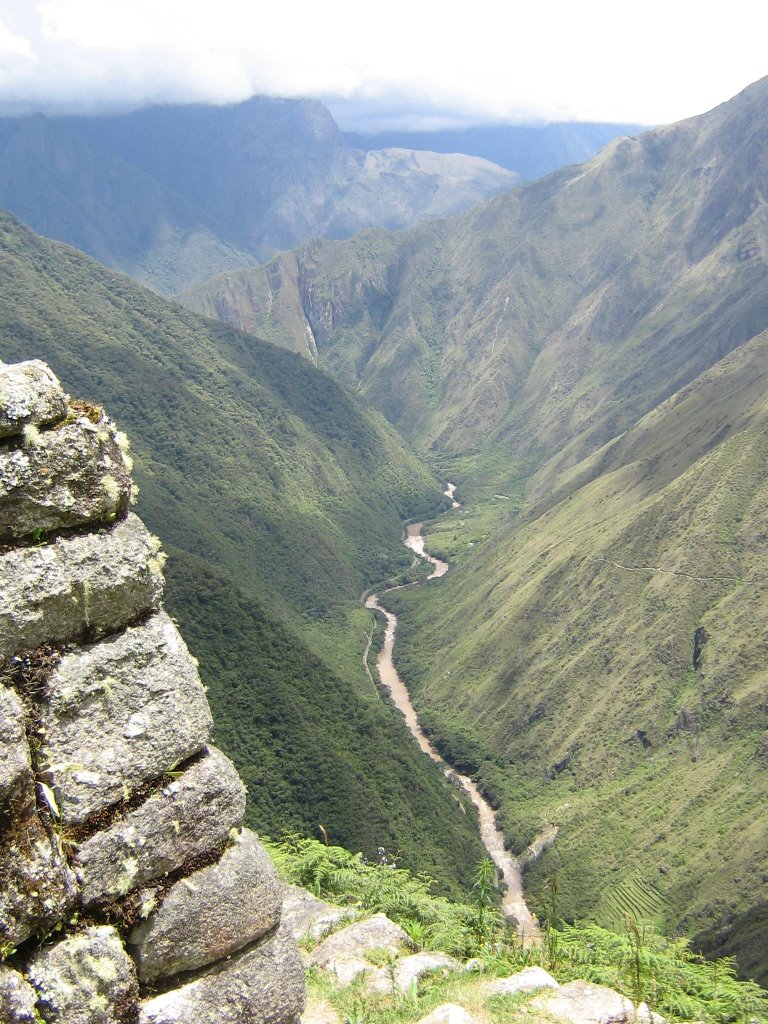
This is the Urubamba river which flows through the sacred valley. The view is from Sayacmarca ruins a sentry point. I provide this level of detail so I can refer back to it in a year, not because you want to know. You can see how dramatic the Urubamba valley is from this picture. In Agua Calientes (Machu Picchu pueblo), which lies at the bottom of the mountains and the entry point to Machu Picchu you really get an view of how uniquely sheer these mountains are, as they shoot off into the cloud and out of sight. Pretty.


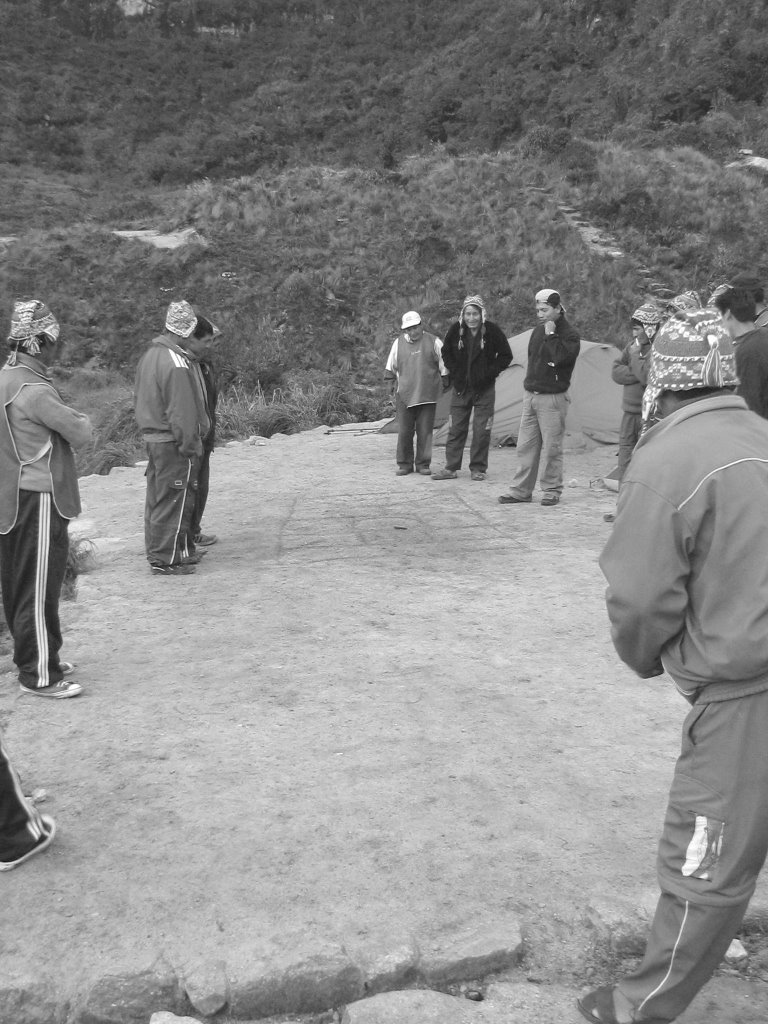
Some of 22 Quechuan porters playing a version of the game 'Sapo' at the Chakiqocha campsite, during a break we had to encourage them to take. One of the good things about using GAP adventures is that they pay the porters a reasonable wage and employ porters up to the age of 63 without shoving them on the scrap heap. At our first campsite (Yunkachimpa) each member of the tour group and each porter introduced themselves and said a few words which went a long way to humanising the group. I gave them a 'long live Quechuan culture' fisted salute. It was met with indifference.

Percy, our group leader (he told me to ask his Dad why he named him Percival), told us a couple of very interesting things about the porters. Percy himself is half Quechuan. Firstly most of the porters have never strayed much beyond the city of Cusco, much less outside the department of Cusco. Percy himself, who I imagine is better more 'wordly' than many of the porters had never seen the ocean until five years ago and he is 31 now. Secondly there is a great deal of stigma about being Quechuan and some of the porters will deliberately speak in Spanish in an attempt to side step this. To put this in context it's been nearly 500 years since the Spanish invaded.

So why do you need the porters? The porters carry all the food, tents, sleeping bags, gas cannisters and water proof mats you need to camp. They run the length of the day's trail before you so they are set up by the time you arrive. They cook all your food and wash up all your dishes. They create drainage ditches around the edges of your tent for when it rains. They wake you with hot water to wash your hands and a drink in the morning. Basically they do everything but wipe your arse. I hope our eventual tip was generous. Supposedly their options for farming locally aren't great because of small land holdings in certain villages.

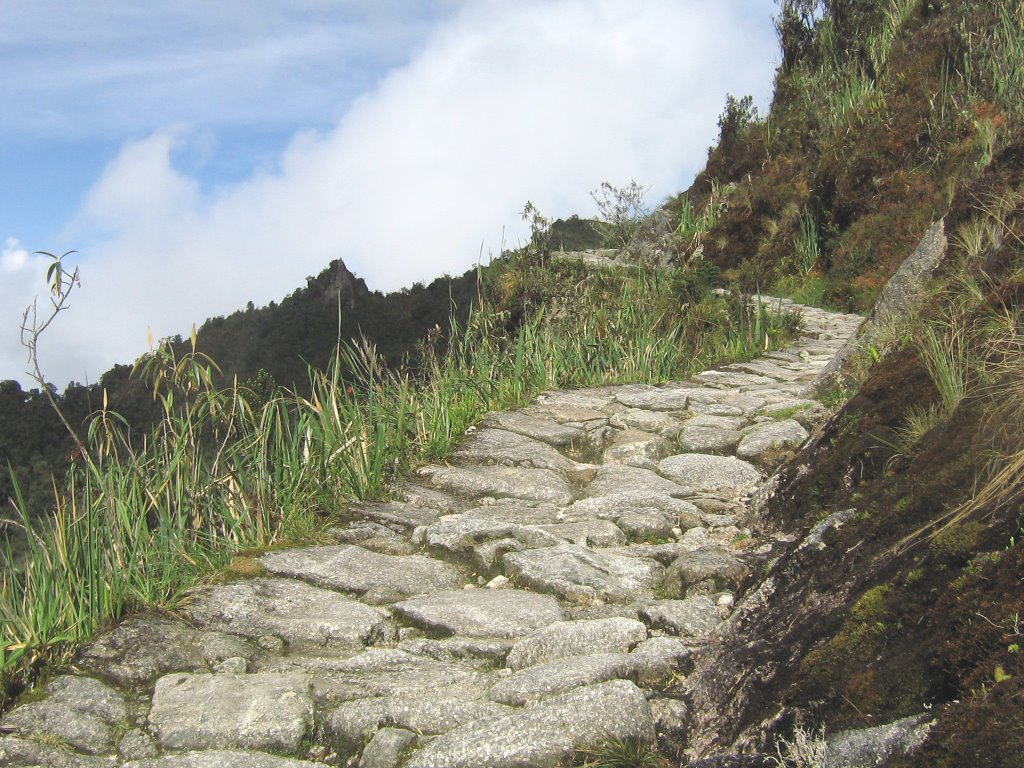
This IS the Inca Trail. Some of it uncovered post Hiram Bingham's 'rediscovery' in 1911, some of it rebuilt. The local Quechuan farmers who lead him to Machu Picchu had always known about it.
When the trails were orginally built it they had channels along which water ran built along their entire length. This maintained the tiring Quechuans. Very few parts of the four day trek route have this feature today.

I still find it hard to believe that Percy managed to do the entire four day hike in eight and a half hours on one occasion!


View of the snopwcapped Andes from the Chakiqocha campsite at the end of day two. I'm not sure I'll see anything like this again. 'Day two is the hardest' is most people's assessment of the trail. It is true that Dead Woman Pass in the morning is a challenge, but I would say most people, as long as they aren't truely unfit, could manage it. One woman in our party had two false hips.


All the tour parties gathered at the Sun Gate. Ha ha! Losers! This is what should be known as the Cloud Gate, supposedly the best vantage point for your first view of Machupicchu. Actually I ran to be the first one here, there was nothing to see but whispy whiteness. Incidentaly I was first one to climb to climb Dead Woman Pass and Runkuraqay High Pass too. Except for the porters.


This is me at the top of Waynapicchu, the mountain overlooking Machu Picchu which you can see in the photo at the top.

I'm glad I went travelling, 'cos it means I can do this sort of stuff.

Back to your Turkey sandwiches, or Guinea Pig if you're Quechuan. I'll be having a picnic in the sun somewhere.

Sunday, December 03, 2006

El perro solo en el altiplano

10th December 2006, Day 265

Qosco, Peru

At the beginning of this week, the future of South America was at a cross road of sorts. Since Hugo Chávez was elected in 1998 he has been promising a second Bolivarian revolution in South America. To complete this goal he faced a tough general election, which would make or break the leftist movement he inspired together with his vision of a new South American unity.


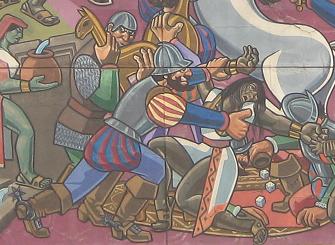
The photo to the left is detail from a mural in Qosco (the Quechuan name for Cusco) and it represents something which arguably Bolivarianism or more specifically Chavismo is aiming to put right. The Spanish conquests of the 16th century, spelled disaster for the indigenous American civilisations. After losing long battles against the invaders, native American people were decimated by murder, enslavement and non-native diseases accompanying the conquistadors. It spread like a epedemic from the pockets at which the invaders arrived and pushed inland. Estimates vary widely but some indigenous groups suggest that as many as 200 million native people were reduced in number to 12 million. Of those who did survive as slaves to work the land for precious metals, they lived a half-life as an intolerably hard life and new religion was forced upon them. As so many indigenous Amercians slaves died they had to be supplemented with slaves from Africa, who existed in the same state of misery. The land and rights that were taken away from the Americans were partially restored after the indepedence of the states, in order to make a distinction from the Spanish rule, a period decribed below:


'Spain did pass some laws for the protection of the indigenous peoples of its American colonies, the first such in 1542; the legal thought behind them was the basis of modern international law. Taking advantage of their extreme remoteness, the European colonists revolted when they saw their power being reduced, forcing a partial revoking of these New Laws. Later, weaker laws were introduced to protect the indigenous peoples but records show they had little effect. The restored Encomenderos exploited the Indians rather than taking care of them.' (Source: Wikipedia).


Since the wars of independence fought in most South American states overthrowing the Spanish, widely lead by Simón Bolívar in the first part 1800's, oppression of the indigenous American population has been stemmed but there has been no overarching attempting to redress the crimes the indigenous peoples faced over the centuries nor reparations made. Today, Chávez's 'democratic socialist' model, he promises, is an attempt to establish some sort of equality in Venezuela and beyond, whilst providing a direct alternative to the world's trajectory of neoliberalism.


Regardless of Chávez's general politics, it is undeniable that his administration has done great deal for the poor Venezuelan population most conspicuously through the Plan Bolivar 2000, anti-poverty program carried out by the military, including mass vaccinations, food distribution in slum areas, and education, but also land reforms. Poverty is largely synonymous with the indigenous population in most of Latin America, as well as significant chunks of the mestizo
population. So whilst I wander around admist beggars and poverty, I wonder 'is something major about to change for the majority of South Americans?' In Venezuela and Bolivia one could argue that it already has, through this land reform and redistribution of wealth. The self-proclaimed 'axis of hope' across South America is slowly widening, most recently with the election of Rafael Correa in Ecuador this November. Although European by ancestory himself, he sets himself apart from other Ecuadorian politicians by being able to speak a dialect of Quechua, Kichwa which is spoken widely in Ecuador.

Despite this broadening coallition, Chávez faced the general election in Venezuela last week with some uncertainty: the cross roads. Had he lost, there is every chance a dam might have formed to cut off his 'red tide'. His challenger, Manuel Rosales, was credited with uniting a fratured opposition and he did represent a semi-serious threat to Chávez's grip on power. Possibly to the relief of the Venezuelan working class, in the end Chávez won the election by a subtantial margin - 61 percent of the vote.

We are now in Qosco, the oldest continually inhabitated city in the whole of South American and the capital of the sun-worshipping Inca empire correctly known as the Quechuan empire. Qosco therefore represents a heartland of the indigenous population, though of course Quechua people are just one of a huge number of pre-Colonial peoples. The Quechua language is still spoken spoken by 10 million people in South America, and unites a large proportion of indigenous peoples. Qosco isn't a bad place to reflect on the present situation for indigenous and mestizo lower classes, and to look at the resistance they made to colonial forces, to hold onto their identity and culture to the present day.

* * *


On a personal note, before we arrived in Qosco we travelled around other parts of Perú and Bolivia. A few weeks ago James and I were in recovery mode from altitude sickness, tired and slightly frightened of the outside world. We felt that we'd arrived in the real Perú as we moped around the altiplano city of Puno. Following a very cold night in a single glazed bedroom, I didn't envy the local population who brave temperatures colder than those in the UK with fewer of the conveniences of home i.e. central heating. I was cold and this is summer! Insulation can't have been up to much, as in Puno and much of the Perú I travelled around many of the buildings look poorly constructed with single brick partions. Maybe this is an illusion of bare walls minus cosmetic plaster and paint. In any case, energy isn't available everywhere in the same quantity, I reckon a cold Perúvian winter so far above sea level is something to avoid.

This was our first taste of the Peruvian and Bolivian altiplano, an area at least 3000 metres above sea-level on a plateau atop the Andes. Despite the temperature at night, it's a place which it's very easy to get misty eyed and poetic about. Even considering the altitude sickness we suffered for a week on our ascent and the dried Alpcaca foetuses I saw on sale in the Mercado de las Brujas in La Paz, I've become very fond of this place. I've never seen anything like it before. The terraced mountain tops and the low cloud drift by silently while packs of sheep or alpacas are herded by women in traditonal dress. The comparitively sparse population and quiet life creates a deceptive impression of tranquility and ease. Life here would be tough. Looking out from with window of the coach as we travelled through along the southern edge of Lake Titicaca it seemed to me that life probably hasn't changed much for some of the campesinos in several hundred years. From Puno, along the edge of Lake Titicaca and across the Bolivian border, only small towns with tourist economies bring the 21st or even the 20th century back into focus. There was plenty to observe; day to day agricultural chores, local weddings (it was a Saturday), a bulldozer prettified with windchimes and bunting repairing part of the rooad and endless lonely dogs padding along the highway in search of food. Of course you don't notice the pestcides and modern livestock feed as you whizz past.
The altiplano has a unique yearning kind of atmosphere. Maybe there isn't too much outside interference here and people quietly get on with their own lives, but I doubt it.

This dreamland is shattered when you reach El Alto, a poor urban complex, but the fastest growing Latin American city which sits on the ridge above La Paz. It's ethnicity is typical of Bolivia's indigenous majority: 79% of its inhabitants are Aymara, 6% are Quechua. Things are raw here and the atmosphere seemed brutal compared to life by the lake. We passed the grim air force base and the dusty streets, as a game of football played by local women was cheered on by an enthusiastic crowd lightening the atmosphere. This didn't change the overall impression of deprivation.

El Alto is a place with much recent significance. During the Bolivian Gas War of 2003, 60 El Alto residents blockading roads and holding strikes were murdered by the armed forces. The gas war was certainly one of the events which significantly contributed to the election of Evo Morales this time last year. There is a good overview of the gas war here, but I will provide some background myself as in many ways it was an indigenous struggle.
The 'war' was brought about by the policies of Morales' predecessor bar one, Gonzalo Sánchez de Lozada. His hydrocarbon energy policy awarded 26 foreign companies (including BP) contracts to extract and siphon off Bolivia's natural gas via a pipeline leading through Chile. Lozada tried to implement this without going through congress, as is demanded by the consituttion. Bolivia has the second most abundant natural gas reserves in South America, and as liquified natural gas is widely seen as the next major energy provider once oil reserves become untenable, the fight over this resource was fierce and bloody. The indigenous majority of Bolivia widely opposed the 'looting' of their natural resources and wanted a larger proportion of profits from the sale of the gas than the measley 18% proposed. The argument of the incumbent government was that profits from the sale of the gas would bolster the Bolivian economy and be reinvested in health and education. They also suggested that only outside investment would be able to pay for the necessary infrastructure for the venture, providing jobs along the way. Most indigenous American Bolivians did not want their massive gas reserves exploited in the way that their silver and gold had been centuries before. They wanted the gas liquified in Bolivia (not in Chile as proposed - the country which wrested Bolivia's route to the sea) and domestic demand satisfied first and foremost.

In September 2003 the protests escalated and road blockades and strikes kicked in demanding the immediate resignation of Lozada. The gas issue also gave the indigenous majority an opportunity to vent their fury over Lozada's complicity towards the US War on Drugs, which proposed decimating coca crops, a vital part of native culture and livelihood. The government resistance culminated in mass direct action which successfully paralysed the country. In El Alto, strategically positioned as the entry point to La Paz, the county was brought to it's knees as food and fuel supplies were blocked. After 16 people were shot on a single day in El Alto, martial law was introduced by the government. These desperate measures saw Lozada's power slipping away and he suspended his gas project before resigning. His replacement, and previous Vice-President, Carlos Mesa promised a referendum and appointed indigenous people to some cabinet posts. The referendum, despite the support of high profile figures such as Morales supporting the vote, was widely seen as loaded and manipulative. It didn't allow a vote for outright nationalisation of hydrocarbons for instance. The result was that tens of thousands protested for full nationalization of hydrocarbons. The pressure reached boiling point and eventually Mesa also resigned, with Morales being elected in the subsequent elections of December 2005.

Here's one man's feeling on the proposed sale of the gas reserves to foreign big business, as he marched from Cochabamba to La Paz to protest against Mesa:

“People are suffering to get here as they have so little money. But I decided to come because we need to reclaim our natural resources. We have been robbed for centuries and our government is robbing us again.”' (Source: ZNet, Nick Buxton)

In this instance, but at no little personal cost, the indigenous population won. If the tide of neoliberalism can be stopped in it's tracks by a largely native American movement, then the politics of the continent are turning.

Whilst we were in La Paz, we had the oppportunity to look at a potent and controversial symbol of indigenous America: the coca leaf. The Coca museum was small but well researched and had an comprehensive written english guide to accompany the exhibits. The coca leaf is intricately linked with many aspects of prehistoric Andean culture and has been proved to have been used since around 2,000 B.C. The leaves were (and still are) used in socialising, worshipping and working. The coca plant was marked for eridacation by the Catholic church and categorised as 'diabolical'; a barrier to conversion of indigenous Americans to Christianity. These measures were quickly revoked when the Spanish realised they could use coca to exploit the workers - the stimulant effects of the plant made the slaves work harder in mines and on plantations as the plant relieved the symptoms of exhaustion and hunger. There was plenty of explanation of how coca was seen as a empowering symbol of resistance during colonial times, even though it simultaneously contributed to indigenous exploitation. It had secret weapon statues to the native Americans: it was considered poisonous to the white man and beneficial only to the native. Coca trading, chewing and production represented a state of mind, culture and spirituality. It was a method of keeping blood pumping through the veins of a, now clandestine, native way of life. It was therefore part of a resistance movement.
Because of it's use in cocaine, the coca plant (which is still, contrary to popular belief, used to flavour Coca Cola) is seen an albatross around the neck of South America by some economist and the source of their poverty. Coca production is targeted by the States as the source of it's huge narcotic problems. Needless to say the story is extremely complicated. In indigenous eyes, however, The U.S. sponsored annihilation of coca crops as part of it's
War on Drugs, is seen as little more than neocolonial activity to keep the native americans down.
President Evo Morales is the head of Bolivia's cocalero movement – a union of coca leaf-growing campesinos who are campaigning against the actions of the United States government to destroy coca in the province of Chapare in southeastern Bolivia. Perhaps this is another aspect of indigenous life which has survived destruction and is returning to the top of the wheel of fortune.

Native resistance to invasion was born at the start of colonialisation and continues to this day. Inca Garcilaso de la Vega, himself a mestizo, was perhaps the first person to try and record some of history of Quechuan people and the Spanish conquest of Perú. His book 'Comentarios Reales de los Incas', was subsequently banned by Carlos III of Spain. Indigenous resistance for all native american groups from Canada to Cape Horn has a vast and fascinating history, there is an excellent article here.

Enabled by certain governments aboriginal American culture reasserts itself together with self-empowerment. A particularly inventive form of cultural reclaimation we observed was the Urban Virgins exhibition by Ana de Orbegoso at the Museo Inca, which employed the same assimilation of cultures the Conquistadors once used to subvert the lives of millions of people. Urban Virgins tries to superimpose indigenous culture on Catholicism, 'by removing classical European features from the face of the divine archetype in Peruvian colonial paintings, and replacing them with the images of present day Peruvian women.' An example of the colonial tradition this lampoons, is to be found in the former Quechuan shrine Qorikancha in Qosco. It was once the very centre of the Inca empire which stretched out north to Colombia, south to Chile and east to Argentina. Once the Spanish arrived they partially destroyed the shrine and built a Dominican Monastery on the top.


If a corner is being turned to a better future for indigenous American people we will know it when the poverty which is spread across the continent is hugely diminished. Here are some photos of life in South America today as we've seen it:

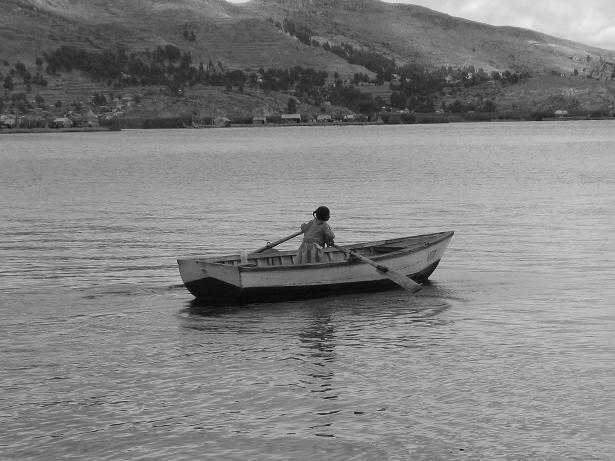
A girl from the reed constructed Uros Islands rows a boat on Lake Titicaca. I imagine the kids are taught to be self-sufficient from a young age. Whilst we were on the islands we got an idea of how the islanders have adapted to use tourism for their survival.
Some of the kids who are taught at their local school to sing in 6 different languages rowed up to us in their boat and gave us a show. They looked a little timid and probably would have preferred to be somwhere else, but their show didn't last that long and they got some money. I had to do a lot of things I didn't want to do when I was their age!


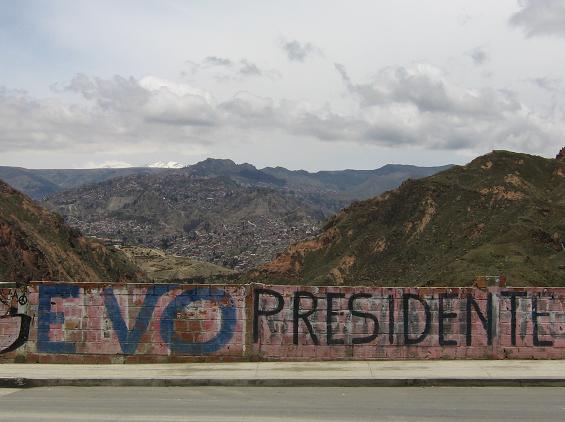
Support for Evo Morales, in a surprisingly posh suburb south of La Paz by Valle de La Luna. Indeed Evo's election was undeniably a watershed in South American politics. He is the country's first indigenous head of state since the Spanish Conquest over 470 years ago. Shortly before we arrived in Bolivia, Morales' land reform legislation had been passed. Morales has been considered as too moderate by some of the left for his preparedness to negotiate over the nationalisation of hydrocarbons (which he eventualy achieved) and as a strategic radical posing as a moderate supporter of democracy by western economists.


Plaza Pedro D Murillo, La Paz. James and I frequently encountered military marches and presence in Bolivia. This is the country which has suffered more military coups than any other, a staggering sixty! You can only imagine how tired of disorder and uncertainty the population must be. To what extent Morales achieves his political aims with the help of the military, or how long he might hang on to power if he is out of favour with it, must be at the back of most Bolivian's minds.


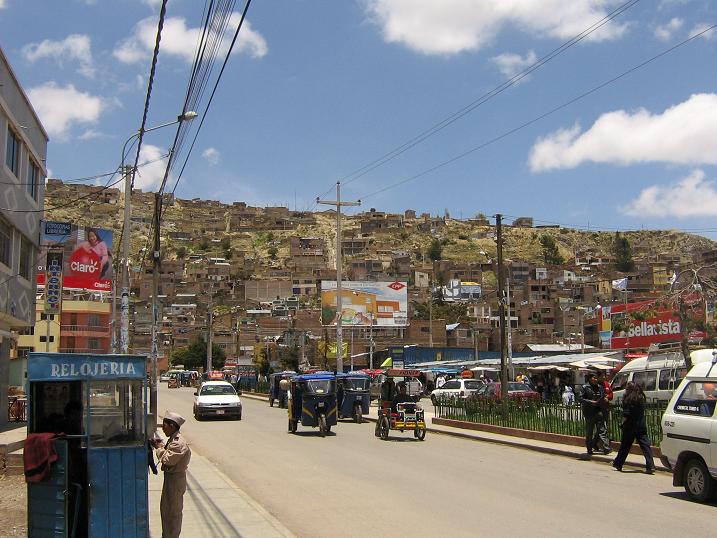
Puno, a Peruvian town on the edge of Lake Titicaca. When we first arrived in Puno, a city of about 100,000 people, it seemed like the real Perú to me and James. James is probably fed up of me describing the population of of places in terms of the number of times bigger our location is than Windsor, by now. I suppose the change we were observing was between low-land and campesino lifestyle. Puno has gringo infrastructure, mainly Avenida Lima, an area crowded with restaurants and souvenir shops with you might find in any tourist resort, but the atmosphere feels different to the coastal desert region.


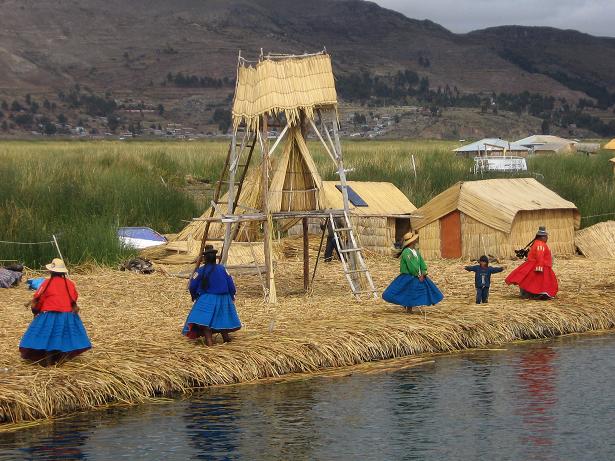
A traditional welcome on one of the main floating Uros floating islands. We were treated to this as we arrived on our boat. Because of the novel way in which they live, the Uros people are perhaps more familiar to tourists than surrounding native peoples. With no islands in Titicaca left to occupy, the Uros made their own out of reeds, which they continue to do to this day! They speak Aymara after their own Uro languge died out, whilst trading and intermarrying with those on the shore. The Uros people were forced out into Lake Titicaca not by the Spanish, but in fact the Quechau, who threatened their lives. I do not mean to create the impression in this post that all pre-colonial America was a place of harmony. It most certainly was not. That does not diminish the impact of colonisers who eclipsed and swamped all existing peoples to the point of genocide.

A message in the reeds on the Uros Islands, Lake Titicaca. This curio has been dusted off for tourists, but the orignal intention of these reeds hanging down from the line was to communicate to other islanders without them having to come 'ashore'. The number and length of reeds would indicate whether the island was occupied and how well stocked it was with food, for example. Like many traditions, preserving elements of a lifestyle via tourism is not a very good method - everything is for show - but it is one that is available. I bought a shawl sewn by one of the women on the island for 50 soles. It is better to buy from the source rather than going through a shop. For the smaller societies tourism is likely to remain the main way of preserving a (somewhat amended) way of life for many years to come.


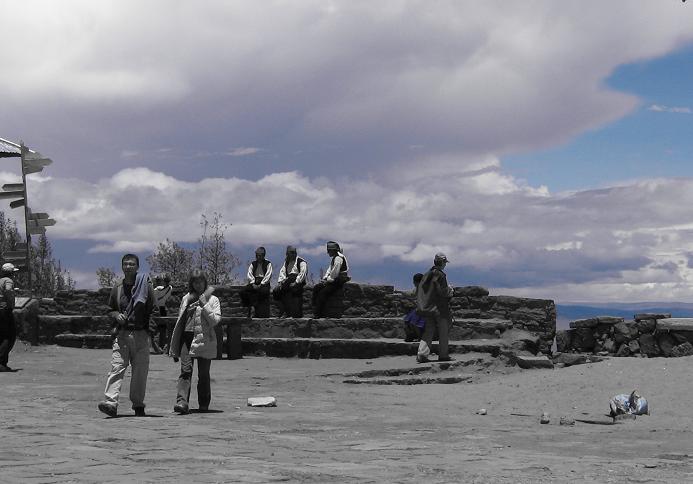
In this picture the tourists and locals mix on Taquile Island, Lake Titicaca. It was part of the Quechuan empire and held out against the Spanish for a long time. Eventually when the Spanish arrived the Taquile residents were forced to adopt the traditional Spanish dress they still wear today. The island today runs on the basis of Quechuan collectivism, but it also relies on tourism. Plenty of tours like ours arrive everyday to wander around the island and buy the textiles and clothing they produce. When we arrived there seemed to be more division between the tourists and the locals than on the Uros Islands. The people were not unfriendly but they tolerated tourists rather than embracing them. They do have a specially recreated gringo invasion every single day... The local children were persistant in selling what I know as 'friendship bands', which is to be expected. The grumpy reaction and snapping of some of our fellow tourists in the group, I thought was unnecessary and frankly ignorant.

Saturday, November 25, 2006

A highway runs through it: the lament of the Nazca Lines

28th November 2006, Day 253

Arequipa, Peru

I'm a bit ill today. This is the first time I've felt off colour since I was in India back in March/April, so I'm not doing too badly really. We arrived in
Arequipa - the white city, constructed from white sillar stone - yesterday after another of the over night bus rides you'd really rather avoid. Arequipa is 2,300 metres above sea level and that's the sort of height where altitude sickness kicks in. After feeling tired all day we cooked some spaghetti in our hostel's dodgy kitchen. A night of many trips to the toilet and an aching stomach followed. I was then woken up at midday by someone rattling the bedroom door violently. When I went to find out just what was going on, I realised that the ground was shaking due to a small tremor. Very foreign!

Nazca, which we've just left for Arequipa, is the most noteworthy place I've been to in Peru so far. Many people are familiar with the
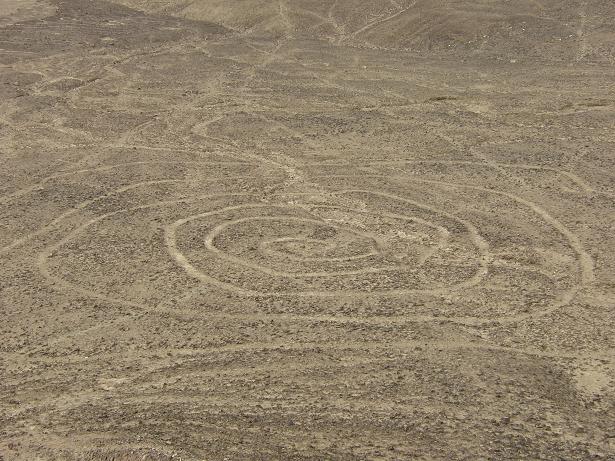
Nazca Lines - large land drawings or geoglyphs which can only be appreciated from the air. In fact the geoglyphs cover over 200 square miles. The purpose of these lines has been the subject of much debate and wonder. The huge figures include a monkey, a hummingbird, a spider, a condor, a dog etc. Sadly before the lines were rediscovered by Dr. Paul Kosok in 1939, the Peruvian stretch of the Pan American highway had already been built right through part of the lines. You can see a photo of the road next to the geoglyphs of James' latest blog entry. Despite many years of research since the lines were rediscovered, no scientific conclusion has been reached as to why the lines were built in the first place. The main theories are thus:

1.
Maria Reiche. The first major researcher (her archeological partner Dr. Paul Kosok stopped work on the lines in 1948) and one of the most respected, Maria believed that the lines were primarily an astronomical calendar, with geoglyphs for summer (the Hummingbird) and winter (the Condor) equinox. The geoglyphs calibrated the year into a calendar and made sense of the heavens by tracking their movement - a unique observatory.

2.
David Johnson. David is still conducting research but believes that the lines referred to where subterranean water could be found in this arid location - in other words the Nazca lines are a giant water map. The large pointing arrows supposedly indicate under ground sources of water.

3.
Robin Edgar. Robin theorised that the Lines were a response to an unusal period of solar eclipses that took place around the time when the Nazca Lines are suspected to have been constructed. The geoglyphs were to be seen by a giant 'Eye in the Sky' - which is the way that the sun and moon might have appeared to the Ancient Nascas during a total eclipse.

4.
Jim Woodman. This theory is based around the feeling that something as large as the Nazca Lines could only have been produced for an aircraft's perspective. Woodman managed to construct a hot air balloon from materials and techniques available at the time, to add strength to his argument.

5.
Erich von Däniken. Erich believed that the lines were created as runways for Alien spacecraft. I think this is a cracking idea.

This photo of the monkey geoglyph was taken by the Peruvian airforce photographic service on behalf of Maria Reiche. In the late afternoon of our first day in Nazca, I had the good fortune to stumble across Viktoria Nikitzki, who runs the Maria Reiche centre which is also her home. We were looking for the centre - mentioned in the Lonely Planet - and had no idea who the busybody was staring us down outside a dusty brick building. 'Is that your washing? I can help you with that... if you are here for my lecture.' We were indeed looking to kill two birds with one stone, so she called out to one of her nieghbours cycling past and soon our dirty linen had been taken in by some bemused local women, who blinked in uncertainty at two sunburnt gringos. Aside from getting our washing done, Viktoria turned out to be one of the most mysterious and compelling people I've ever met. She was a personal friend and disciple of Maria Reiche. We agreed to meet her later for the lecture, and went back to our poorly ventilated and hence smelly hostel. I'll name and shame the place actually - Alegria II - the sheets were dirty and I would compare the smell of our room to vinegar mixed with dirty socks. Foul.

We returned to Victioria's spartan home at seven o'clock for the evening lecture, by which point it was dark. We stumbled through a dimly lit and ramshackle anteroom into her 'lecture theatre', the largest room in the house with a mud floor and single lamp to light a scale model of the Nazca Valley. This came in to view gradually as the light warmed up. Barely had James and I settled down on the stone bench before Viktoria rejoined us. Unprovoked, she doled out what I would call 'a piece of her mind' to James and I. I didn't mind, however. I received the impression that she would just have easily have shared the same information with a three year old or a mafia stooge pointing a gun at her head. To put it simply she didn't give a toss. Being a bit of a wimp myself I always admire this attitude in people. We talked a little at the beginning about South American politics whilst we waited for some other customers who ultimately never showed up: she praised Chavez and Morales, but employed a grave tone to describe the former's relationship with Castro. She declared Cuba to be the only Latin American country with a monarchy! Aside from that, all bitterness was directed against Bush, and his attempts to unsettle the fledgling neo-socialist movement spreading across the continent. Her speech was littered with frowns, knowing looks, pregnant pauses and grins. She had a well-turned 'woe is me' element to her character which she brought up now and again to her advantage. She was deliberately comedic, then suddenly serious as she talked about her effort to 'save' the lines without the tools to do it. She painted a picture of herself surrounded by unscrupulous bureaucrats and nincompoops. Maybe it was true.

You could describe Nikitzki as 'weird' I suppose. James had a number of intelligent questions to ask about the lines that she simply didn't answer because it wrested the perogative away from herself. I'm not doing the best job of making her sound charming, but she was to me (although I sympathised with James, who still valued the experience). Clearly European by origin, I asked Viktoria where she was from - 'I am from cosmos' she replied. I suspected that she might have been German like her friend Maria Rieche, but James reckoned she was French on the basis of her gesticulations. She went on to talk about her neighbours, one of whom sells Coke on the street side, while her teenage daughter goes to discos (she will be pregnant within the year according to Viktoria - she's sounds like a conservative politican from 1991 now doesn't she?). She scruched up her face. Within Viktoria's 'cosmos' Coca-Cola does not exist.


A brief digression. Around here Coke is delivered in tank like vehicles and they sponsor the street signs. There's not much competition in Peru, everything in the supermarket seems to be made by a few companies - mainly Coke, Nestle or Unilever.
The local 'Inca Kola' used to have much bigger share of the soft drinks market in Peru than Coca-Cola, so they bought them out. The same happened in India with a cola drink called 'Thums Up'.
Coke make a big deal of the fact they are franchised on a country by country basis supporting local economies. So they're not a multinational at all, see? Why do they have a CEO and international board of directors then?Enough of my pet obsessions.

Back to the Maria Reiche centre. To elaborate on my earlier point, the mian thing Viktoria lamented about Peru was the endemic corruption and the poor education which has hatched an aquiescent attitude among the poor (which is the overwhelming majority of the population). She described a hypothetical situation in which an official might spit upon a local: 'hmm, perhaps the wind blew the wrong way' would be the response of the average Peruvian, she thought. She'd recently heard (we think incorrectly) that there was an attempted coup against Morales in Bolivia and she was upset that there was no one in Nazca to discuss it with. Her dignity refuses to allow her to leave Nazca. Having met her I felt she was isolated and I pitied her a little, which she would have hated.

OK... so what about the Nazca Lines? That was the point of the lecture, wasn't it? We did get onto them eventually. Gratitude. That summed up what the lines were about according to Viktoria (she was doing a good job of talking from her own perspective not Maria Reiche's, but this was clear with a bit of research). In what way were the Lines about gratitude?
The lines were built by Ancient Nazca civilisation (300bc-800ad) from which the site now take it's name. According to Maria Reiche, who studied the lines for 50 years, they an elaborate astronomical calendar created to mark risings and settings of the sun, moon and stars. This is outlined in her publication
'Mystery on the Desert' (first published in 1949). The crux of Reiche's work was based around where the sun's rays fell during sunrise at Summer and Winter equinox. The Hummingbird (which is associated with the warm summer months) was built at the point the sunlight reached at summertime and the Condor with it's huge beak the winter solstice. This was also a place for ceremonies to celebrate life and give thanks for it.

We moved onto hydrology. I may be wrong, but it seemed Viktoria again mixed her own opinion with that of Reiche; at least so far as we can tell in Reiche's book. Viktoria talked about water - large triangular pointers were 'drawn' to signify locations of subterrean water ways (also proposed by Johnson). Viktoria produced some divining rods and two bottles of water, at this point - one full the other half full. After waving some rods around a bit she demonstrated the art of divining... if you were prepared to use your imagination a bit.

I hope I am not being too facetious about Viktoria; really the bulk of her work is pretty serious, and I am not trying to make light of that. Quirks and foibles are what gives a personality colour, which is why I mention them. I truly admired her, even if I did take a little of what she said with a pinch of salt.

A wonder of the world (though not in any official sense), the huge geoglyphs probably won't be around for decades to come. Viktoria is negative about the future of the lines. She is convinced they are being destroyed. In recent years the inhabitants of Nazca have been dumping their rubbish, (plus that left by tourists) on the pampa or plains. How long before it becomes a huge mountain the eats up the 'glyphs? More importantly, as Maria Reiche pointed out as long ago as 1976, the area, which was previously almost rain free, has been receiving increased precipitation year on year for long time.
In Viktoria's words:

"There has been deforestation everywhere so water from the highlands comes down to the Lines in streams and rivers. The Lines themselves are superficial, they are only 10 to 30cm deep and could be washed away. There is no maintenance or any sort of care for the Lines. Also there is threat by the weather. Nazca has only ever received a small amount of rain. But now there are great changes to the weather all over the world. The Lines cannot resist heavy rain without being damaged."

The Nazca Lines are supposed to be a
UNESCO world heritage site, which means they should receive some form of funding to help preserve them in the long term. Viktoria is adamant that no work is being done to protect the lines, and thinks that UNESCO is a load of nonsense. She reckons whatever money might be received for the protection of the lines goes straight into the pockets of Peruvian politicians, civil servants or officials. The Maria Reiche Centre is calling for international intervention to protect the geoglyphs, and wants local pollution controls and irrigation systems to divert water away from them. Viktoria doesn't think they'll listen to her, despite endless letters and overtures to government departments, archaeological and environmental groups.

Before we left her for the evening, Viktoria intentionally sent us on a guilt trip about wandering away from her lecture without doing anything to support the cause of the Lines. The following day I returned to Viktoria's house to help cut down what she called 'the Espinola tree' in her backyard (NB: removing the tree and preserving the lines may not be directly related). Armed with a vicious machete I set about this task whilst trying to avoid her pet turkey and kittens with the falling foliage. 'No! Too big, you must chop it up and throw over the back wall' were Viktoria's barked instructions when I lopped off the first large branch. I spent three hours being scratched by large thorns and balancing precariously on a crumbling brick walls, so this was a bit of a fool's errand. The thing is, I do take the odd measured risk, and this was not comparable to an Evil Kneivel stunt. I just wanted to put Viktoria's mind at rest as she continually referred to some (possibly exaggerated) security threat - she thought people could climb into her sealed yard via the low hanging branches. Anyway, I laboured away for a while with the help of another German volunteer and got rid of the best part of the tree. 'My cat will be waiting for you when you get down if you drop a branch on him', said Viktoria with a toothy grin which reminded me of Mark E. Smith.
James turned up fresh from his flight to help for the last half an hour or so, and Viktoria was grateful for the work. We were rewarded with some jam she made from the pods of the tree I was chopping down.

In the afternoon, after I washed off four years of dust from 'the Espinola tree' and went for a more affordable tour of Nazca than the flights. My guide Jan (short for Janssen not Juan), was a trained archaeologist and a very pleasant guy to boot. He was about my age and we got on very well. Before we set off, I tried to verify some of the general points Viktoria had made with Jan. He agreed that there were huge problems with corruption, but thought that the situation was a little more complex than Viktoria suggested - particularly education on historical sites in Peru for Peruvian nationals. He had a distinct personality to Viktoria; I asked him what his pet theory on the Nazca lines was and he said 'nothing is believed until proven in archeology.' I was going to receive a very different perspective.

Before we started the tour I wanted to find out a little about Jan and he appreciated the opportunity to take his tourist guide hat off for a moment. Jan talked a little about the basketball coaching he did on Saturdays for a couple of hours in a poor village near Nazca. He wasn't too downbeat about the country's future and talked about his wife and child and his ambition to get back into archeology and work in Egypt. He also talked about how much he loved the Rolling Stones and the rock band he was in himself. When 'I'm Free' hollered by a young Jagger came on the radio in van on the way back, I thought he was going to punch the window in joy.

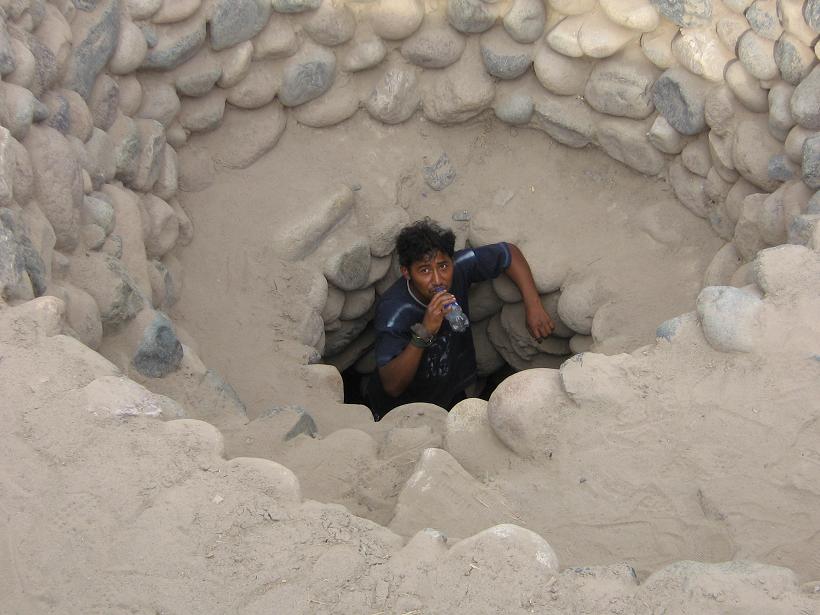
Our first stop was at the aqueducts, built by the ancient Nazcas (300bc-800ad). I am not totally certain but I believe these were built to preserve and improve access to natural waterways. Channels were cut down into the turf at the point which the water was closest to the surface. They were an amazing feat of engineering. Reeds which grew up from the large stone banked channels, blocking the passage of the water were cut away each year by the Nazca population, with individuals travelling down inside the meadering and fractured subterranean channels. It was a job which was delicate and very dangerous. Very few of the orginal aqueducts have been repaired or altered and they are still used today. A mark of the quality of the water is the numerous little fish which you can see swimming in the channels. Spiral walkways were built down to some of the openings for carrying large water containers down to the water and back up with ease (some wells were as deep as 20 metres).

Next we travelled on to some of the outlying geoglyphs; places not covered by UNESCO status. Jan talked for a while about the established uses of the Lines of which there is really just one. They were definitely used in ceremonial rituals of one kind or another, their other purposes are open to theory. This has been established via a myraid of fine ceramic found in all the geoglyphs. Jan was more concerned about the plight of these geoglyphs and the rubbish dumping I mentioned before, than what is happening to the better known lines which the plane tours cover each day.

One surprising thing is the limited industry in the area. Jan showed me some of the iron and aluminium ore which is abundant here. Also present is copper, silver and even gold. Indeed there is one gold mine owned by Canadians heading towards Cusco, and Peru is major player in extracting some of these metals. Frankly I'm amazed, however, that this area isn't off limits having been sold to hard rock mining companies. I understand that hard rock mining is nowhere near as easy and profitable as mining for fossil fuels, but if we are talking about copper (because of the components of modern electronic devices) and gold, well, that's a different and more profitable matter.

Now we step forward dramtically in time. At our final stop we looked at some of the much later
Inca Empire's (1197ad-1533ad) construction in the area. Las Ruinas de Paredones, are the remains of an Incan fort built around 1412 from which the head 'Inca' who ruled the whole settlement could view the whole Nasca valley. It was quite a vantage point.

I was charged a fee of ten soles to visit all the places Jan took me, but evidence showed the behaviour of some tourists who visited these places was poor. The site with it's crumbling bricks were not supported or off-limits to tourists at any point. Peru always has a major battle on it's hands because earthquakes frequently destroy relics of it's rich historical past. Indeed that's the main reason Los Paredones looks the way it does today. That doesn't excuse people walking along the walls, scratching their names in the mud brick or leaving their rubbish in the site itself. 'At least people don't play games of football here any longer', sighed Jan. He made a big point that most destruction of important geological sites in Peru was caused by national rather than international tourism. Whilst we looked at the mud bricks I saw plenty of western names scratched into the former walls, though.

As we headed back into Nazca itself Jan invited me to watch him play basketball that evening and I gladly agreed. I don't know much about Peruvian basketball, needless to say! Sadly James and I had to skip town that night, as the only buses to Arequipa were at night and we didn't fancy kicking our heels in Nazca for another day. When I went to meet Jan to offer my apologies he turned up happy and smiling with his wife and small child. He accepted my excuses with good grace, but I felt like a right idiot.

A few more pictures. The aqueducts built around Nazca by the Ancient Nascas have been well preserved and as you see, are still in use today! Jan chatted to these local guys who were knocking around on Saturday afternoon eating Mango Verde with salt. They knew what I was getting at when I stuck my tongue out in revolt. In fact I thought we were establishing some level of rapport when Jan indicated it was time for the geoglyphs.


Other things we've done in Peru...

Our first port of call after Lima was Pisco (famous for it's grape of the same name). Just below Pisco lies the Parracas peninsula from where you can catch a boat to it's primary tourist attraction, the Islas Ballestas. These isles shelter a veritable feast of wildlife, with Pelicans, Emperor Penguins, Pelicans, Boobies and Sealions. We got some great snaps.


Emperor Penguins on Islas Ballestas. One of the most surprising things about the islands was how intermingled all the different bird species were, boobies, penguins, pelicans and cormorants all stood side by side, apparently not bothering one another.


This is Huacachina, a desert town (which exists for tourists) built around an oasis. We stopped here for the sandboarding that we read about in our Lonely Planet. This involved travelling in a the kind of sand-dune buggy they warn you not to get in on the Foreign and Commonwealth office website. Hey, it had roll cage! The actual boarding (very similar in principle to snowboarding) was not easy. We had several opportunities to throw ourselves off dangerously steep banks, with next to no guidance and no skiing or snowboarding experience necessary. There's a great shot of me rolling down the dune with my bottom hanging out. With much charity James didn't publish it on his blog.