Saturday, November 25, 2006

A highway runs through it: the lament of the Nazca Lines

28th November 2006, Day 253

Arequipa, Peru

I'm a bit ill today. This is the first time I've felt off colour since I was in India back in March/April, so I'm not doing too badly really. We arrived in
Arequipa - the white city, constructed from white sillar stone - yesterday after another of the over night bus rides you'd really rather avoid. Arequipa is 2,300 metres above sea level and that's the sort of height where altitude sickness kicks in. After feeling tired all day we cooked some spaghetti in our hostel's dodgy kitchen. A night of many trips to the toilet and an aching stomach followed. I was then woken up at midday by someone rattling the bedroom door violently. When I went to find out just what was going on, I realised that the ground was shaking due to a small tremor. Very foreign!

Nazca, which we've just left for Arequipa, is the most noteworthy place I've been to in Peru so far. Many people are familiar with the
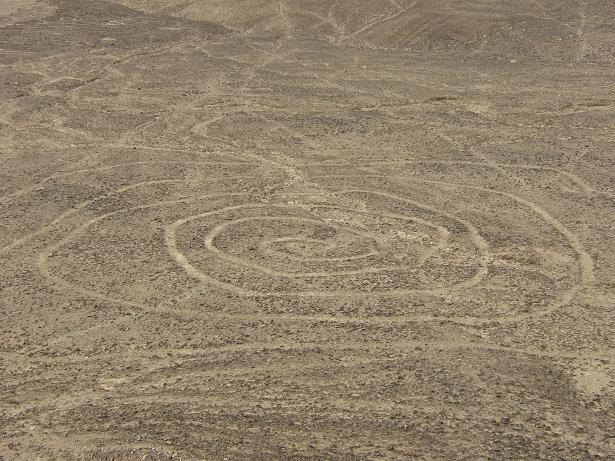
Nazca Lines - large land drawings or geoglyphs which can only be appreciated from the air. In fact the geoglyphs cover over 200 square miles. The purpose of these lines has been the subject of much debate and wonder. The huge figures include a monkey, a hummingbird, a spider, a condor, a dog etc. Sadly before the lines were rediscovered by Dr. Paul Kosok in 1939, the Peruvian stretch of the Pan American highway had already been built right through part of the lines. You can see a photo of the road next to the geoglyphs of James' latest blog entry. Despite many years of research since the lines were rediscovered, no scientific conclusion has been reached as to why the lines were built in the first place. The main theories are thus:

1.
Maria Reiche. The first major researcher (her archeological partner Dr. Paul Kosok stopped work on the lines in 1948) and one of the most respected, Maria believed that the lines were primarily an astronomical calendar, with geoglyphs for summer (the Hummingbird) and winter (the Condor) equinox. The geoglyphs calibrated the year into a calendar and made sense of the heavens by tracking their movement - a unique observatory.

2.
David Johnson. David is still conducting research but believes that the lines referred to where subterranean water could be found in this arid location - in other words the Nazca lines are a giant water map. The large pointing arrows supposedly indicate under ground sources of water.

3.
Robin Edgar. Robin theorised that the Lines were a response to an unusal period of solar eclipses that took place around the time when the Nazca Lines are suspected to have been constructed. The geoglyphs were to be seen by a giant 'Eye in the Sky' - which is the way that the sun and moon might have appeared to the Ancient Nascas during a total eclipse.

4.
Jim Woodman. This theory is based around the feeling that something as large as the Nazca Lines could only have been produced for an aircraft's perspective. Woodman managed to construct a hot air balloon from materials and techniques available at the time, to add strength to his argument.

5.
Erich von Däniken. Erich believed that the lines were created as runways for Alien spacecraft. I think this is a cracking idea.

This photo of the monkey geoglyph was taken by the Peruvian airforce photographic service on behalf of Maria Reiche. In the late afternoon of our first day in Nazca, I had the good fortune to stumble across Viktoria Nikitzki, who runs the Maria Reiche centre which is also her home. We were looking for the centre - mentioned in the Lonely Planet - and had no idea who the busybody was staring us down outside a dusty brick building. 'Is that your washing? I can help you with that... if you are here for my lecture.' We were indeed looking to kill two birds with one stone, so she called out to one of her nieghbours cycling past and soon our dirty linen had been taken in by some bemused local women, who blinked in uncertainty at two sunburnt gringos. Aside from getting our washing done, Viktoria turned out to be one of the most mysterious and compelling people I've ever met. She was a personal friend and disciple of Maria Reiche. We agreed to meet her later for the lecture, and went back to our poorly ventilated and hence smelly hostel. I'll name and shame the place actually - Alegria II - the sheets were dirty and I would compare the smell of our room to vinegar mixed with dirty socks. Foul.

We returned to Victioria's spartan home at seven o'clock for the evening lecture, by which point it was dark. We stumbled through a dimly lit and ramshackle anteroom into her 'lecture theatre', the largest room in the house with a mud floor and single lamp to light a scale model of the Nazca Valley. This came in to view gradually as the light warmed up. Barely had James and I settled down on the stone bench before Viktoria rejoined us. Unprovoked, she doled out what I would call 'a piece of her mind' to James and I. I didn't mind, however. I received the impression that she would just have easily have shared the same information with a three year old or a mafia stooge pointing a gun at her head. To put it simply she didn't give a toss. Being a bit of a wimp myself I always admire this attitude in people. We talked a little at the beginning about South American politics whilst we waited for some other customers who ultimately never showed up: she praised Chavez and Morales, but employed a grave tone to describe the former's relationship with Castro. She declared Cuba to be the only Latin American country with a monarchy! Aside from that, all bitterness was directed against Bush, and his attempts to unsettle the fledgling neo-socialist movement spreading across the continent. Her speech was littered with frowns, knowing looks, pregnant pauses and grins. She had a well-turned 'woe is me' element to her character which she brought up now and again to her advantage. She was deliberately comedic, then suddenly serious as she talked about her effort to 'save' the lines without the tools to do it. She painted a picture of herself surrounded by unscrupulous bureaucrats and nincompoops. Maybe it was true.

You could describe Nikitzki as 'weird' I suppose. James had a number of intelligent questions to ask about the lines that she simply didn't answer because it wrested the perogative away from herself. I'm not doing the best job of making her sound charming, but she was to me (although I sympathised with James, who still valued the experience). Clearly European by origin, I asked Viktoria where she was from - 'I am from cosmos' she replied. I suspected that she might have been German like her friend Maria Rieche, but James reckoned she was French on the basis of her gesticulations. She went on to talk about her neighbours, one of whom sells Coke on the street side, while her teenage daughter goes to discos (she will be pregnant within the year according to Viktoria - she's sounds like a conservative politican from 1991 now doesn't she?). She scruched up her face. Within Viktoria's 'cosmos' Coca-Cola does not exist.


A brief digression. Around here Coke is delivered in tank like vehicles and they sponsor the street signs. There's not much competition in Peru, everything in the supermarket seems to be made by a few companies - mainly Coke, Nestle or Unilever.
The local 'Inca Kola' used to have much bigger share of the soft drinks market in Peru than Coca-Cola, so they bought them out. The same happened in India with a cola drink called 'Thums Up'.
Coke make a big deal of the fact they are franchised on a country by country basis supporting local economies. So they're not a multinational at all, see? Why do they have a CEO and international board of directors then?Enough of my pet obsessions.

Back to the Maria Reiche centre. To elaborate on my earlier point, the mian thing Viktoria lamented about Peru was the endemic corruption and the poor education which has hatched an aquiescent attitude among the poor (which is the overwhelming majority of the population). She described a hypothetical situation in which an official might spit upon a local: 'hmm, perhaps the wind blew the wrong way' would be the response of the average Peruvian, she thought. She'd recently heard (we think incorrectly) that there was an attempted coup against Morales in Bolivia and she was upset that there was no one in Nazca to discuss it with. Her dignity refuses to allow her to leave Nazca. Having met her I felt she was isolated and I pitied her a little, which she would have hated.

OK... so what about the Nazca Lines? That was the point of the lecture, wasn't it? We did get onto them eventually. Gratitude. That summed up what the lines were about according to Viktoria (she was doing a good job of talking from her own perspective not Maria Reiche's, but this was clear with a bit of research). In what way were the Lines about gratitude?
The lines were built by Ancient Nazca civilisation (300bc-800ad) from which the site now take it's name. According to Maria Reiche, who studied the lines for 50 years, they an elaborate astronomical calendar created to mark risings and settings of the sun, moon and stars. This is outlined in her publication
'Mystery on the Desert' (first published in 1949). The crux of Reiche's work was based around where the sun's rays fell during sunrise at Summer and Winter equinox. The Hummingbird (which is associated with the warm summer months) was built at the point the sunlight reached at summertime and the Condor with it's huge beak the winter solstice. This was also a place for ceremonies to celebrate life and give thanks for it.

We moved onto hydrology. I may be wrong, but it seemed Viktoria again mixed her own opinion with that of Reiche; at least so far as we can tell in Reiche's book. Viktoria talked about water - large triangular pointers were 'drawn' to signify locations of subterrean water ways (also proposed by Johnson). Viktoria produced some divining rods and two bottles of water, at this point - one full the other half full. After waving some rods around a bit she demonstrated the art of divining... if you were prepared to use your imagination a bit.

I hope I am not being too facetious about Viktoria; really the bulk of her work is pretty serious, and I am not trying to make light of that. Quirks and foibles are what gives a personality colour, which is why I mention them. I truly admired her, even if I did take a little of what she said with a pinch of salt.

A wonder of the world (though not in any official sense), the huge geoglyphs probably won't be around for decades to come. Viktoria is negative about the future of the lines. She is convinced they are being destroyed. In recent years the inhabitants of Nazca have been dumping their rubbish, (plus that left by tourists) on the pampa or plains. How long before it becomes a huge mountain the eats up the 'glyphs? More importantly, as Maria Reiche pointed out as long ago as 1976, the area, which was previously almost rain free, has been receiving increased precipitation year on year for long time.
In Viktoria's words:

"There has been deforestation everywhere so water from the highlands comes down to the Lines in streams and rivers. The Lines themselves are superficial, they are only 10 to 30cm deep and could be washed away. There is no maintenance or any sort of care for the Lines. Also there is threat by the weather. Nazca has only ever received a small amount of rain. But now there are great changes to the weather all over the world. The Lines cannot resist heavy rain without being damaged."

The Nazca Lines are supposed to be a
UNESCO world heritage site, which means they should receive some form of funding to help preserve them in the long term. Viktoria is adamant that no work is being done to protect the lines, and thinks that UNESCO is a load of nonsense. She reckons whatever money might be received for the protection of the lines goes straight into the pockets of Peruvian politicians, civil servants or officials. The Maria Reiche Centre is calling for international intervention to protect the geoglyphs, and wants local pollution controls and irrigation systems to divert water away from them. Viktoria doesn't think they'll listen to her, despite endless letters and overtures to government departments, archaeological and environmental groups.

Before we left her for the evening, Viktoria intentionally sent us on a guilt trip about wandering away from her lecture without doing anything to support the cause of the Lines. The following day I returned to Viktoria's house to help cut down what she called 'the Espinola tree' in her backyard (NB: removing the tree and preserving the lines may not be directly related). Armed with a vicious machete I set about this task whilst trying to avoid her pet turkey and kittens with the falling foliage. 'No! Too big, you must chop it up and throw over the back wall' were Viktoria's barked instructions when I lopped off the first large branch. I spent three hours being scratched by large thorns and balancing precariously on a crumbling brick walls, so this was a bit of a fool's errand. The thing is, I do take the odd measured risk, and this was not comparable to an Evil Kneivel stunt. I just wanted to put Viktoria's mind at rest as she continually referred to some (possibly exaggerated) security threat - she thought people could climb into her sealed yard via the low hanging branches. Anyway, I laboured away for a while with the help of another German volunteer and got rid of the best part of the tree. 'My cat will be waiting for you when you get down if you drop a branch on him', said Viktoria with a toothy grin which reminded me of Mark E. Smith.
James turned up fresh from his flight to help for the last half an hour or so, and Viktoria was grateful for the work. We were rewarded with some jam she made from the pods of the tree I was chopping down.

In the afternoon, after I washed off four years of dust from 'the Espinola tree' and went for a more affordable tour of Nazca than the flights. My guide Jan (short for Janssen not Juan), was a trained archaeologist and a very pleasant guy to boot. He was about my age and we got on very well. Before we set off, I tried to verify some of the general points Viktoria had made with Jan. He agreed that there were huge problems with corruption, but thought that the situation was a little more complex than Viktoria suggested - particularly education on historical sites in Peru for Peruvian nationals. He had a distinct personality to Viktoria; I asked him what his pet theory on the Nazca lines was and he said 'nothing is believed until proven in archeology.' I was going to receive a very different perspective.

Before we started the tour I wanted to find out a little about Jan and he appreciated the opportunity to take his tourist guide hat off for a moment. Jan talked a little about the basketball coaching he did on Saturdays for a couple of hours in a poor village near Nazca. He wasn't too downbeat about the country's future and talked about his wife and child and his ambition to get back into archeology and work in Egypt. He also talked about how much he loved the Rolling Stones and the rock band he was in himself. When 'I'm Free' hollered by a young Jagger came on the radio in van on the way back, I thought he was going to punch the window in joy.

Our first stop was at the aqueducts, built by the ancient Nazcas (300bc-800ad). I am not totally certain but I believe these were built to preserve and improve access to natural waterways. Channels were cut down into the turf at the point which the water was closest to the surface. They were an amazing feat of engineering. Reeds which grew up from the large stone banked channels, blocking the passage of the water were cut away each year by the Nazca population, with individuals travelling down inside the meadering and fractured subterranean channels. It was a job which was delicate and very dangerous. Very few of the orginal aqueducts have been repaired or altered and they are still used today. A mark of the quality of the water is the numerous little fish which you can see swimming in the channels. Spiral walkways were built down to some of the openings for carrying large water containers down to the water and back up with ease (some wells were as deep as 20 metres).

Next we travelled on to some of the outlying geoglyphs; places not covered by UNESCO status. Jan talked for a while about the established uses of the Lines of which there is really just one. They were definitely used in ceremonial rituals of one kind or another, their other purposes are open to theory. This has been established via a myraid of fine ceramic found in all the geoglyphs. Jan was more concerned about the plight of these geoglyphs and the rubbish dumping I mentioned before, than what is happening to the better known lines which the plane tours cover each day.

One surprising thing is the limited industry in the area. Jan showed me some of the iron and aluminium ore which is abundant here. Also present is copper, silver and even gold. Indeed there is one gold mine owned by Canadians heading towards Cusco, and Peru is major player in extracting some of these metals. Frankly I'm amazed, however, that this area isn't off limits having been sold to hard rock mining companies. I understand that hard rock mining is nowhere near as easy and profitable as mining for fossil fuels, but if we are talking about copper (because of the components of modern electronic devices) and gold, well, that's a different and more profitable matter.

Now we step forward dramtically in time. At our final stop we looked at some of the much later
Inca Empire's (1197ad-1533ad) construction in the area. Las Ruinas de Paredones, are the remains of an Incan fort built around 1412 from which the head 'Inca' who ruled the whole settlement could view the whole Nasca valley. It was quite a vantage point.

I was charged a fee of ten soles to visit all the places Jan took me, but evidence showed the behaviour of some tourists who visited these places was poor. The site with it's crumbling bricks were not supported or off-limits to tourists at any point. Peru always has a major battle on it's hands because earthquakes frequently destroy relics of it's rich historical past. Indeed that's the main reason Los Paredones looks the way it does today. That doesn't excuse people walking along the walls, scratching their names in the mud brick or leaving their rubbish in the site itself. 'At least people don't play games of football here any longer', sighed Jan. He made a big point that most destruction of important geological sites in Peru was caused by national rather than international tourism. Whilst we looked at the mud bricks I saw plenty of western names scratched into the former walls, though.

As we headed back into Nazca itself Jan invited me to watch him play basketball that evening and I gladly agreed. I don't know much about Peruvian basketball, needless to say! Sadly James and I had to skip town that night, as the only buses to Arequipa were at night and we didn't fancy kicking our heels in Nazca for another day. When I went to meet Jan to offer my apologies he turned up happy and smiling with his wife and small child. He accepted my excuses with good grace, but I felt like a right idiot.
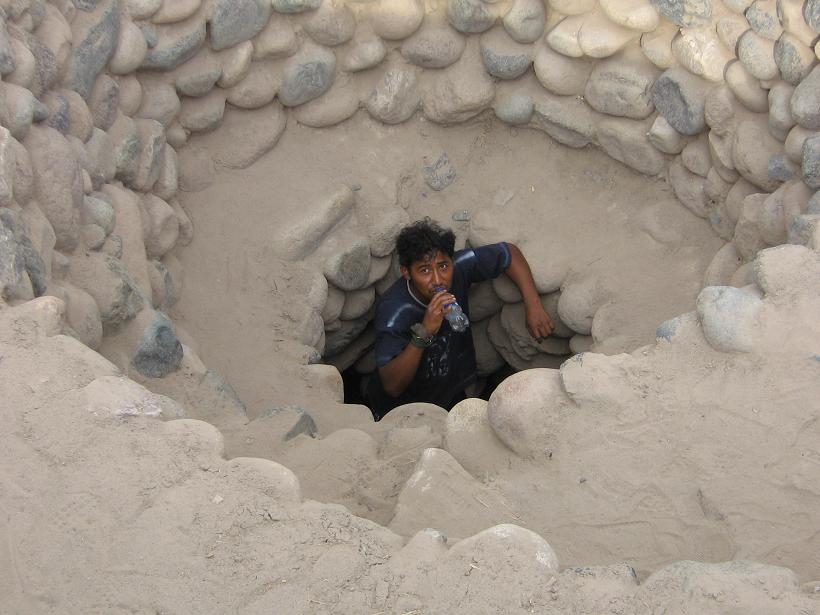
A few more pictures. The aqueducts built around Nazca by the Ancient Nascas have been well preserved and as you see, are still in use today! Jan chatted to these local guys who were knocking around on Saturday afternoon eating Mango Verde with salt. They knew what I was getting at when I stuck my tongue out in revolt. In fact I thought we were establishing some level of rapport when Jan indicated it was time for the geoglyphs.


Other things we've done in Peru...
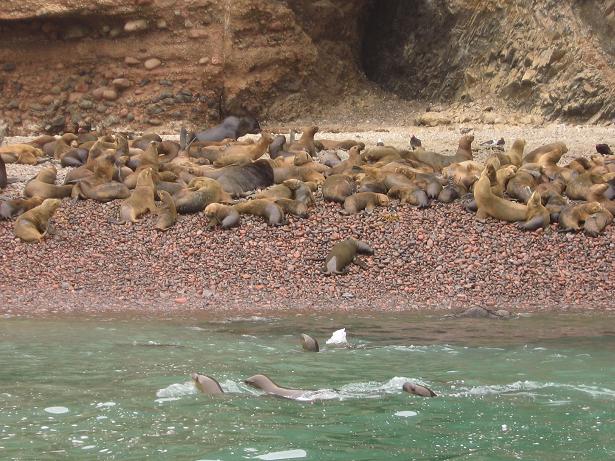
Our first port of call after Lima was Pisco (famous for it's grape of the same name). Just below Pisco lies the Parracas peninsula from where you can catch a boat to it's primary tourist attraction, the Islas Ballestas. These isles shelter a veritable feast of wildlife, with Pelicans, Emperor Penguins, Pelicans, Boobies and Sealions. We got some great snaps.
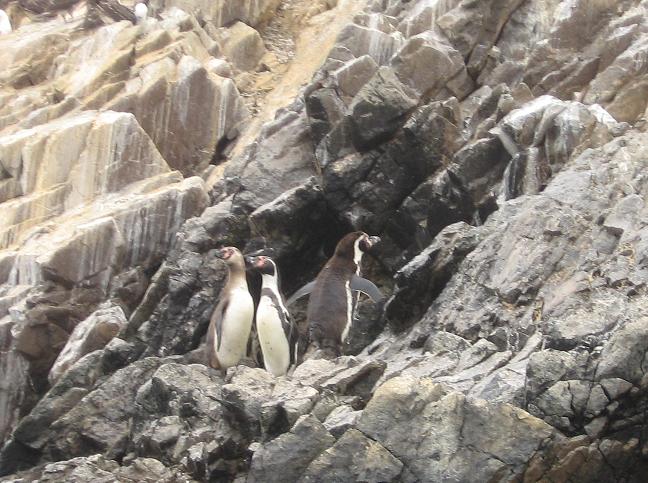


Emperor Penguins on Islas Ballestas. One of the most surprising things about the islands was how intermingled all the different bird species were, boobies, penguins, pelicans and cormorants all stood side by side, apparently not bothering one another.


This is Huacachina, a desert town (which exists for tourists) built around an oasis. We stopped here for the sandboarding that we read about in our Lonely Planet. This involved travelling in a the kind of sand-dune buggy they warn you not to get in on the Foreign and Commonwealth office website. Hey, it had roll cage! The actual boarding (very similar in principle to snowboarding) was not easy. We had several opportunities to throw ourselves off dangerously steep banks, with next to no guidance and no skiing or snowboarding experience necessary. There's a great shot of me rolling down the dune with my bottom hanging out. With much charity James didn't publish it on his blog.

Saturday, November 11, 2006

Watching the Penguins

11th November 2006, Day 235

Santiago, Chile

I write this as a nervous and hungover shell of a man. A merry night out in Barrio Bellavista with Roberto, our friend and part-time tour guide, went a bit wrong when I slipped into the bad old ways and drank far too much Chilean lager. I don't remember whether the band we saw, Espia, were up to much, but I do remember talking a lot of nonsense to Roberto and his mate. Despite a comfortable week of cultural assimilation, today I nervously staggered around in the blinding light of the midday Santiago sun having forgotten all the vocabulary I'd learnt in the expensive Spanish classes we'd taken and reverting to apprehensive alien status. Indeed I felt feeble and rather crass. This is my chance to redeem myself.

We are, of course, now in South America. This has dragged me out of a package tourist ditch which I'd complicitly slid into in Australia and New Zealand. It doesn't feel like I'm halfway home any longer, these four months will be a challenge I've not hitherto experienced during these travels. Some of the stereotypical adjectives associated with Latin America (vibrant, colourful), are not especially appropriate for Santiago, which is widely regarded as one of the most European cities in atmosphere in the sub-continent. It is, however, a massive change from the last three months of familiarity and also a land where the majority of people do not speak English. Good lord!

Fortunately I have a muse (of the online variety) and consequently I have thought of something to write about. Instead of opening this post with a nice view of Santiago cupped by the Andes and the coastal mountains, I've challenged myself to do something less obvious. So here's Tweety Pie masked up and ready to go. As you may be aware Santiago amd Chile itself has recently been shaken from, what I would imagine, is it's usual orderly and efficient day to day business. During May student strikes, starting with direct action in April, reached a peak with minor riots breaking out. On 1st June President Michelle Bachelet announced some educational reforms which met many of the student's demands and the strikes were called off by student leaders. The pace of the introduction of the legislation is still causing problems, however. The dust has yet to settle on this predicament and the city walls bear plenty of evidence of unrest over the last six months.


I'll have to ask for a correct translation of this, but with the help of an internet translator, this stencil says something like, 'Neither vote nor annul, get on the street and protest! The rich continue to prosper'. This revolt captured the imagination and creativity of the students as well as cultivating a little rebellion for rebellions sake. We've seen this through the grafitti artwork around the city, student interest in political theory and systems, vandalism and a heavy police presence on the street. I don't think I've ever seen so many anarchy symbols in one place, for what that's worth.

There is a lengthy article on the strikes hosted on Wikipedia; events which have become known as 'the March of the Penguins' in reference to the student's uniforms.

James and I have seen a lot of the students ourselves whilst wandering around the city. Staring is a more accurate term than seeing, really. The girl's uniform is rather revealing around the top of the leg. This is not really appropriate behaviour for two men approaching 30. Regardless, the students are verging on the ubiquitous and I would imagine that combined they were a formidable force a few months ago.

Chile has a large proportion of young people, a quarter are 14 or under for instance. According to the Wikipedia article (I should really use another main reference):

'The country suffers from a rigid class stratification issue, with a poor majority of close to 60%, although extreme poverty rates declined in the 1990's and today accounts for close to 20%.'

The quality of state education is generally viewed as poor among Chileans. Add this to the central legislation around teaching introduced by the Pinochet regime (the Constitutional Teaching Law) which has not been altered much in over 15 years of democracy and you begin to identify some of the catalysts for this incident.


Whilst literacy rates in Chile are extremely high, the public perception that state education in Chile is poor is strong and increasing according to the articles I've read. Half of all those students who finish their high school education fail to gain access to higher education via an entrance exam, or can barely afford the test at all.
One columnist commented that the crux of the strike lay in the fact that while the private schools turned out the wealthy, the state schools churned out workers to preserve a long established class system.

The Organic Constitutional Law on Teaching (LOCE), which I mentioned above is criticised for:

'reducing the state's participation in education to a solely regulatory and protective role, whilst the true responsibility of education has been transferred to private and public corporations (public schools being managed by local governments — Municipalidades), thus reducing the participation that students, parents, teachers and non-academic employees had previously enjoyed in their schools.' Source: Wikipedia.

Revoking of the LOCE was the
big ask of the students. In simple terms the direct action could be seen as a fight for simple educational change or representation in government decision making. Among the more progresive and radical elements it was undoubtedly seen as a fight against the government or indeed the beginnings of a class war.

The ultimate catalyst for this year's unrest was Michelle Bachelet's announcement towards the end of April that the university entrance test (PSU) fee would increase and free student bus travel would be restricted. General anger from state students boiled over. Outrage, intial demonstrations and school takeovers followed. In the subsequent weeks the Coordinating Assembly of Grade School Students (ACES) organised the strikes with the following demands:

- free bus fare
- waiving of the university admissions test fee
- the abolition of the Organic Constitutional Law on Teaching (LOCE) and an end to municipalization of subsidized education
- a reform to the Full-time School Day policy (JEC)

Considering that these were young school children it's not surprising that action was diverse and sometimes lacked clarity. Depending on your opinion some actions could even be labelled blockheaded at times (ostensibly unecessary violence and vandalism), but this youthful melting pot also spawned the vision I mentioned above. Indeed those protests which turned violent intially dampened public sympathy for the pupil's plight. The kids carried on with their tightly organised occupations and held discussions on political theory and civics inbetween their regular classes. I wonder how many became committed Communists or Anarchists during this time? Over the following days, the student's dedication and perseverence gradually won their actions tolerance and their aims respect among Chileans. The stubborn attitude towards the students demands by the government coupled with a focus on non-violent direct action eventually began to change this public perception, from what I can tell. Education minister Martin Zilic, for instance, proved particularly non-communicative and surly towards the students aims, breaking off negotiations and sending deputies to negotiate with student leaders in his place as the stand off worsened.

I spoke to two Chileans about the strikes. One a friend and university student and the other our Spanish teacher. They both generally supported the strikes. Indeed the strike called by the students and arranged for the 30th May was the
largest in Chilean history, with the main Santiago-based Universities in support. The second strike on 5th June comprised teachers and many unions as well as the students. According to a poll 87% of Chilean's voiced support for the strikes, at their height. Diverse acts of rebellion ranged from occupations and marches to rallies and street fighting.

On the 30th May, the day of the largest strike, the greatest concentration of violent clashes took place. The force of that the caribeneros (uniformed police) employed to deal with violent students and rioting pockets was widely criticised as over the top and effectively incendiary:

[On the 30th May] 'Fighting extended throughout the night, with 725 people arrested and 26 injured. The actions of the police were strongly repelled by the public. Some of the strongest reactions came from the press and the President herself.' Source: Wikipedia.

As a result of the way the Carabineros tackled the riots, the general director of Carabineros dismissed ten officers including the Special Forces Prefect and his deputy.

The things which shock me about the uprising are two-fold. Firstly the organisation and scale of the mobilisation coupled with the age of those organising (average age 16) is a surprise. Mobile phones, text messaging and email were the tools they employed. There is a related article about how the children organised themselves here, which contains links to the various student's blog sites divided by school. It is notably creative, spontaneous and encouraging. There are some particularly striking photos here.
The strike of the 30th of May comprised up to a million students! I find this quite staggering for a movement which was barely a month old by the time it successfully mobilised a generation of children.

Secondly they have, to some extent, won. After Bachelet's reforms, hastily announced on 1st June, subsequent delays in introducing legislation are almost over. According to my friend 'legislation has been passed regarding scholarships for the PSU(university entry exam), it is now free for the poorest half. The reduced bus fare for school kids now runs 24 hours.' Criminal charges against individual student leaders were dropped. My friend points out this may have been to prevent a student backlash. Some of these Assembly leaders were extremely young, such as María Jesús Sanhueza, an outspoken 16 year old Communist.

The long term goals for education, such as the abolition of LOCE, are still under discussion. There are still problems with the student leaders on Bachelet's panel who do not necessarily have the backing of the students that they previously held. The political awakening and ambition that has been aroused in these children may be satisified through negotiation and engagement with the government, but perhaps it won't.

Having spoken to university student and a teacher, there is a mixed opinion about the events in retrospect. My uni student friend said:

'It's great, this generation of kids are the first to be born since the return of democracy, so they don't have any of the prejudices generations like mine must have, they never knew a military goverment and that may have something to do with their active political participation. I can see my generation being much more apathic politically.'

My teacher was more sceptical, despite a general sympathy. He thought that completely free bus travel at all times was too much to ask, and that the students long term ambitions were naive. I suspected he strongly objected to any violent actions. He felt that they should be looking at repealing the PSU rather than the LOCE, which he saw as the key to changing the country's fortunes. He believed that repealing the LOCE was a solution to pre-dictatorship Chile, not today's society. According to him the current education system needed strong redirection in Chile to re-engage bored students, after the sound first four years of schooling. He felt everybody looked at the PSU success rates as the arbiter of Chile's fortunes, and that it was totally misleading. More emphasis needed to be placed on pre-graduation testing and vocational courses, as well as changing the current municipal curiculum priorities.

There is little doubt that the direct action of what ever form achieved something, even if the long term goals of the students are ultimately comprimised. What about the violent element, though? As someone who immensely dislikes violent action but does not reject violence outright as a defensive measure, I can't see how to justify it easily in this instance. No doubt it gained the students media attention and it also brought a quick direct response from the President, but continual NVDA would likely eventually have brought about the same negotiations. Without being present during the marches and rallies, I have no idea whether the students were provoked by the police or whether a fight was sought. Even then a provocation does not necessarily justify a violent response. It is true that the young people may have found it harder to contain their frustration than older individuals with more life experience. Certainly the police's response on the 30th May has been recognised even by the government as unacceptable. The campaign's successes seem to have been achieved by largely by NVDA. Perhaps I am wrong.


Focusing on the strike probably paints a skewed picture of Santiago, which is certainly not a city on a knife edge. It's generally very safe and has a pleasant atmosphere.

Roberto, a friend we met through an internet music forum we use, kindly came to pick us up from the airport and took us up the famous Cerro San Cristobel - a public park on a massive hill overlooking Santiago. Here's the token shot of Santiago I mentioned at the start of the post! This photo was taken that day. The crowd by the marquee were celebrating a special mass. It was a quaint introduction to a new continent.

This Sunday I decided to run from our hostel up the winding road to touch the Virgin Mary at the top of the San Cristobel, which is over 850m high. It was a bit tough after a few weeks without much exercise, and I crawled the last few steps to the sacred mother in exhaustion. Fortunately, and by coincidence, a kind bloke I'd met over breakfast was sat on the steps leading up to the monument and with a look of pity he offered me some fresh pineapple. After some small talk between gasps of air and half-chewed pineapple, I headed back down the hill again.


This is Pablo Neruda's dining room in Bellavista. I know very little about Latin American literature, apart from a couple of lectures and seminars at university on Borges. Indeed, I had only read any Gabriel Garcia Marquez a few weeks before we landed in Santiago. I was essentially unaware of Isabel Allende and her father. I'm a dumbass.

Whilst I work on finishing the Roberto Bolaño novel my Chilean friend leant me and get around to reading some Neruda myself, here's a bit about the man who is supposedly the person to inspire more people to read poetry than anyone since Shakespeare; he even read poetry to 70,000 people in the National Soccer Stadium in Santiago! He was highly political and a was forced to live as an exile by one government and a collaborator with another. The latter government was headed by the leftist Salvador Allende, Neruda's close friend, but it was brought down by Pinochet's military coup of 1973. Neruda was Communist Senator himself for a spell. His dubious respect for Stalin's dictatorship in Russia is also oft noted. If I am making him sound like an extreme South American version of Bono, I am describing him inadequately. Let me tell you about his house...

Neruda, as well as being a fantastic poet and intellectual, was a bit of a fruit-cake. As you can see he kept his cutlery in the television. Out of shot are a nice pair of condiment pots labelled 'Maruijana' and 'Morphine'. He was an obsessive collector of pretty much anything you can imagine, with a special place for the kitsch: horse memorabilia, toby-jugs, bottles, shoes, books, paintings etc. During the Pinochet coup, Neruda was already hospitalised with cancer and his subsequent fatal heart-attack is widely credited to the ousting of his friend Allende and his socialist project. During this time Neruda's homes in Santiago, La Isla Negra and Valparaiso were ransacked and the majority of their contents destroyed. Despite this the houses remain quirky and unique; a testament to a unique personality. This house in Santaigo 'La Chascona' , is built to resemble a ship, with each room representing a different nautical facet: bridge, galley and even a lighthouse. Strangely Neruda was obsessed with ships despite only sailing once and hating the whole voyage when he was a child. 'Why go to sea when you can recreate the feeling of sailing on land' he was once heard to say, whilst wafting a wine bottle around. What a nutter!

Monday, October 30, 2006

When you get to New Zealand, time's running out

3rd November 2006, Day 227

Wellington, New Zealand

Don't let anyone tell you that two weeks in New Zealand is enough to see the country! I've just received confirmation that I'll be starting back at work in March. Despite the fact I am as far away from home as I could be without leaving planet earth, suddenly home seems to be staring me in the face with a protruding tongue.

Here's a little of what we've done in NZ, though I'll try to avoid offering too much opinion on the place because I haven't been able to make considered observations.

Other than some of the places in South East Asia we visited, I knew less about New Zealand than any other place on our itinerary so far. Trying to fit it in to 12 full days has meant big omissions from the usual tourist trail. Most backpackers/budget travellers tend to use one of the tourist buses to get around NZ - the Kiwi Experience (a kind of Club 18-30 type crowd) or the Magic Bus (a wider mix of ages and fewer three day benders). A few more use InterCity, the state bus service, and then there's people who just rent or buy a car/camper van. Because of the size of New Zealand it's possible to do a tour with Magic/Kiwi Experience and see most of the major attractions in the North and South Island in one 'go'. You can do a number of different routes and James and I were keen on one operated by Magic in the South Island. In the end we just didn't have the time necessary to do it and picked out the things we knew that we were desperate to experience. These fell neatly into three places: Rotorua and the Taupo Volcanic Zone, the Franz Josef glacier and Kaikoura. We booked trips to and fro across the Cook Straight to the South Island and got cracking.

Without planning on it, this was our first opportunity to follow a massive commercial backpacker route. Seeing as we haven't had much of that so far, we were looking forward to meeting a lot of new people easily and less time wasting over logistical guff. Now we're ten days into New Zealand we've have had a nice taste of this, which has cheered me up a bit after occassionally feeling adrift from my peers during the last seven months. I also found my favourite hostel ever in the South Island. We met a lot of Germans, which I thought was fantastic being something of a Germanophile (also I go a bit daft when I hear a girl with a German accent). So, a well worn track isn't always a rut.

Before I talk about the stupendous and often weird places we visited, it worth reflecting that we've used more dedicated tourist infrastructure in New Zealand than we have anywhere else. I generally don't think much about what impact I'm having when I choose to visit a destination; I think about the cheapest way of getting there. This is a default position for travellers and it has to be a conscious effort to think about the effect of your presence and cash in these areas. In a country like New Zealand which most people visit for it's natural beauty, the impact of the massive, constant tourist presence can have the effect of brusing and cutting into the landscape like constricting harness. The most interesting things to visit in NZ are often the places/creatures most delicate and susceptible to human interference.


Having arrived in Auckland on a rainy labour day weekend, I was a bit shocked by the forbidding atmosphere. A lot of pissed up kids were hanging around on Queen Street looking for a fight. Not a great first impression. We decided to head for Rotorua the next day, which had been recommended by a few friends and one of the only ports of call on our sparse list.

New Zealand sits on the convergence of the Indo-Australian and Pacific tectonic plates. The continual friction between these two plates forces the Indo-Australian plate upwards (in simple terms) and creates volcanic and geothermal activity. Rotorua is in the Taupo Volcanic Zone, which contains all manner of bizarre geological sights, sounds and (mainly) smells. The zone fans out from below Lake Taupo in the centre of the North Island and follows an arc north towards Whakaari, the active volcano in the Bay of Plenty. 'Sulphur City' as Rotorua is known, stinks of rotten eggs most of the time and we didn't manage to get used to the aroma during the two days we spent there!

James and I took a morning's trip to one of the main geothermal sites which is a commercial tourist resort, Wai-o-tapu. In the picture above left, you can see some of the bubbling nutrient rich mud that people travel from all over the world to, in order to do their best hippo-mud-wallowing impression and emerge with smooth skin. The heat rising from the mud, geysers and pools creates an ethereal atmosphere as you walk around them. In Wai-o-tapu you can wander through the volatile crater lakes formed by acidic water which was forced up through the nutrient rich water table. Due to their geothermal nature, the lakes are fantastic spectrum of colours which are appropriately named things like 'the Champagne pool' and 'Aritist's palette'. It was a great place to get acquainted with New Zealand's outdoors and it's idiosyncracies.


The Lady Knox geyser. A guide sets this off every morning at 10.15 by dumping a load of washing powder in it. It's a bit fraudulent, but if he didn't do it, I wouldn't have been able to take pretty pictures.

Rotorua is one of the towns in NZ (or
Aotearoa) with the largest Maori population and there's plenty of opportunity to experience Maori culture here. Sadly we didn't have the time to vist the Maori museums, but there is a rich history around the region. Wai-o-tapu, for instance, means 'sacred waters' and is holds a special place in with Maori legend. The Te Papa museum in Wellington will be our chance to educate ourselves a bit.

My flatmate of the last three years, who spent the best part of his life in NZ told me of the large gang culture which operates here, linked to racial division. I wasn't likely to encounter that in two weeks, but there were a few clear signs of racial tension. Whilst in a local boozer in West Port (S. Island) there was a lot of nasty casual racism ('I guess you've noticed the North Island's a lot browner than the south, eh, mate?'). This wasn't the only time I'd overheard these kind of remarks. By the same token, I also saw a bit of 'Black Power' graffitti in Rotorua, which I'm told is gang rather than a movement. I don't want to comment any further knowing nothing about Maori/Pakeha historical relations. It just seems that there's common divisions the world over.


This a great view of the Southern Alps from the edge of Lake Wahapo on State Highway 6. This is typical of the scenery on the western coast of the South Island.

It's common to hear tourists claim that the South Island is where you want to spend your time in New Zealand. On this untested advice we headed straight down to Wellington and across the Cook Straight to Picton after leaving Rotorua. The only way we were going to able to be able to cover the ground from Picton to the Franz Josef glacier, Franz Josef to Kaikoura and Kaikoura to Picton in the 6 days we had on the S. Island was to hire a car and do it on our own terms. Thanks again James - if you didn't offer to drive we wouldn't have seen all that amazing stuff (I lost my driving license in Thailand).

By serendipity, we were able to benefit from our sometime backpacking muse - our friends Dave and Jodie. After leaving Melbourne they'd gone on ahead of us to New Zealand and were heading back from South Island when we encountered them in Picton. Their experience was our gain and the first reliable advice we'd received since landing on NZ turf.


Me on the Franz Josef glacier, S. Island.

Once we hired the car we headed sraight down through Nelson and Murchison through the Buller Gorge, which was a lovely introduction to the dramatic scenery of the South Island.
We were desperate to get a car with some sort of stereo to break up the long periods of driving, but without paying through the nose we couldn't afford a CD player. We settled for a cassette player. Tapes are increasingly difficult to get your hands on these days, but James managed to find a second hand store in Murchison and purchased the following gems:

Truck Driving Hits (surprisingly enjoyable, if dubious in sentiment)
Iggy Pop - Blah Blah Blah (the album with the greatest content of filler ever recorded?)
Barry Manilow- Manilow (no one writes a tune like Baz)

...and last but by no means least, Hot Chocolate's Greatest Hits.

Driving through the Buller Gorge to the dulcet tones of Errol Brown crooning the tender ballad 'It Started with a Kiss' or with the windows wounds down listening to the foot stomping verve of 'Every 1's a Winner' will forever be associated in mind with the ravines and cloud of the South Island. Oh, and an important note: the 1987 Ben Liebrand remix of 'You Sexy Thing' is a big steaming pile of Stock, Aitken and Waterman inspired turd - though it made James laugh.

After an overnight stop in West Port, Franz Josef greeted us the following day with some of the most torrential rain of the last 7 months. It didn't put us off though, and despite waking up to the same conditions the next day, we were up on the glacier itself for a full day's hike a little after 11am. We did this through Franz Josef Glacier guides NZ, one of the two major operators. This is definitely in my top ten of things that we've done whilst travelling.

Glacial hiking has been a commercial acitivity on the Franz Josef for over a century now, but it is now regulated by the Department of Conservation. Strangely the focus of their attention, after doing a quick search on their website, seems to be managing visitor satisfaction rather than protecting the glacier itself. Perhaps that is now considered to be under control.

The glacier itself is under a period of advancing, though this is an anomaly in glacial activity worldwide which indicates that most glaciers are receeding (in terms of their total size) considered over a large number of years. This is a trend which scientist put down to climate change.

Wandering around on the glacier itself wasnt too difficult with the decent equipment provided by the guide operators. We were dry despite the prevailing heavy rain; weather which added to the atmosphere rather than detracting from it. Slipping past ice walls, hopping over crevasses and crawling through an ice hole. It was an altogether different realm from the 'back on the ground', and it was once of those things that quickly seems unreal when you reflect on it. James amazed me by hardly having a single problem with the heights all day.


A Kea. This a type of parrot that only lives in Alpine regions (!), and it truly has a bold nature. Apparently it frequently pinches the glacier guides' lunch and despite frequent sighting it is endangered. Our tour guide mentioned that the way the birds amble up the glacier alongside you makes them look like they're taking the rise. I like them, they certainly had character.


A moulin or drainage hole for meltwater in the glacier. Virgin to the human gaze, I wish they'd had some sort of giant endoscope to poke down in order to view the natural, ingenious plumbing system running through the glacier.
I was pleased at how much of the A-level glacial geography I recalled whilst I was on the tour. Long forgotten terms like moraine and the Rayleigh effect crept back from the recesses of my memory.


After leaving Franz Josef and stopping over night in the picturesque Hanmer Springs, we arrived at Kaikoura for the walk along it's famous peninsula and to see the wealth of marine life up close.


A fur-seal hiding in the bushes at Kaikoura. I walking around to the seal colony with James, halfway along the Kaikoura coastal walk and saw a big crowd of tourists stood on the beach with a great view of some sun-bathing seals. In my rush to get a look, a cut off a corner and almost fell arse-over-tit when some thing growled and barked at me from the bushes. When I recovered, it turned out to be this rather grumpy and aloof looking individual. I didn't associate seals with gentrified car parks. Silly me.

Wildlife rarely appears to be bothered by human presence in organised tourist facilities, but I think that's often a false impression. Clearly work by government agencies such as the Department of Conservation go someway towards stemming the negative impact of human presence in wilderness areas, but better public education on what is likely to cause problems is probably not as forthcoming as it might be. This is probably due to the contribution of tourism to the economy. Sometimes you've got to figure things out for yourself.


The thing which brought about the biggest debate in my mind was the opportunity to see the Kaikouran marine life at close hand. Whale watching, seal swimming and dolphin cruises are all available at Kaikoura. After some quick research online, I decided to go swimming with the dusky dolphins you see to the left.

We used a firm called Dolphin Encounter. A strict tourist quota system is operated by the Department of Conservation, which only allows a certain number of dolphin swimmers in the water at any one time, and only at certain times of day so as not to disturb pods. Our guide happened to be conducting research for Earthwatch Australia/NZ an NGO, who work in partnership with Dolphin Encounter. She gave an impassioned speech on the plight of marine mammals which reassured me that the effect of these interactions were closely monitored. In addition, there was proper guidance given in a briefing video about respecting the dolphins and not touching them.

I am certainly glad we did go ahead. We got fully kitted up in wetsuits, boots, gloves, headmasks, snorkels and fins. When the horn sounded on the boat we slipped into a 12 degree pacific ocean at 6.15am. I admit I was thinking 'I wish I'd stayed in bed' when I first hit the water. All the equipment made it pretty difficult to swim, and my muscles tensed up a bit. After warming up the dolphins were around the vessel and we were 'entertaining' them with all our vigour. We were shown three ways to attract dolphins: swimming in circles, diving and replicated dolphin sounds. The latter method was probably just suggested for the amusement of the on-board crew. It took a bit of snooping around the bay in the boat and several dips until we got a full dolphin pod in our midst. This last swim was especially memorable and the were scores of dusky dolphins all around us, which is the kind of experience which nauseates people when you relate it, so I won't bother!

So what does the future hold for New Zeland's environment? A public-private partnership
exists to sustainably fortify NZ's tourist industry. This supposedly embraces the maori spirit of manaakitanga (hospitality) and kaitiakitanga (guardianship). This has already succeeded in the creation of a NZ Ministry of Tourism. The 2010 strategy is proceeding as expected according the website. The online testimonies suggest that the economic element of sustainability seems to be holding up well, at least.

We'll be in South America, not long after you read this. We're not prepared for it at all, but at least our mate Roberto is waiting to cushion the impact when we arrive in Santiago. Hopefully work and reailty will be pushed into the corner of my mind one final time.

Saturday, October 21, 2006

'Hello' and 'Goodbye' Australia, in photos

21st October, Day 214

Sydney, NSW

Today I've been researching New Zealand at our YHA hostel in Sydney, because we catch our plane to Auckland tomorrow. There's a great room in the hostel designed for people who've just arrived in Australia to plan out their trip. It's a nice, quiet environment with detailed maps of the five states and two territories, plus a wealth of other information to help the baffled backpacker to organise themselves. As a taster of what's on offer, they've put up some professional Australian landscape photography to whet the appetite - Uluru, the Great Barrier Reef, the Kimberley etc. What a big country...


The big decision James and I had to make when we were deciding on the itinerary for this trip was whether we'd travel extensively in Australia, or simply work to fund other parts of the trip. We opted for the latter and we've not really seen Australia as a result. I'm not too regretful. Looking at those photos it made me realise that we could only have seen a small chunk of Australia in three months, even if money had been no object. We did manage to set aside our last three weeks to see some Antipodean natural delights; the things which make you want to see this country in the first place. We began by hiring a car for a few days and visiting the Great Ocean Road in Victoria - just west of Melbourne - and briefly the Dandenong Ranges, which are foothills of the Great Dividing Range. After heading back to Sydney this week, we spent two days in the Blue Mountains (foothills by the middle of the Great Dividing Range), which were my favourite part of the Australia, in retrospect. I don't have much to say about the things we saw, it's better to represent our last few weeks through a few photographs.

So goodbye Australia. Only one thing annoys me. When I get home I won't be any better placed to reminisce with my Mum (who spent two years there during 1968-1970), because I saw nothing of Queensland, the Northern Territory or Western Australia. I need the chance to come back!

The Twelve Apostles (only eight apostles are left!), on the Great Ocean Road, VIC. These are limestone outcrops eroded by the crashing sea waves. In the bottem left of the picture you can see the crumbled remains of the 9th apostle which crumbled on July 3rd last year!


London Arch, Great Ocean Road, VIC. Another arch which connected this limestone arch to the mainland collapsed in 1990, prompting it's name change from London Bridge to London Arch.


Sandstone ridges, not limestone at the Blue Mountains, NSW.


Cascade over the Blue Mountains, NSW.


A lizard (I'll amend when I've found out which species), Blue Mountains, NSW.


Blue-tongue lizard, Blue Mountains, NSW.


A Tiger Snake we encountered, Blue Mountains, NSW.


Shingleback Lizard, Tower Hill Game Reserve, Great Ocean Road, VIC.


Thanks to the random stranger for helping with lizard classification!

Tuesday, October 03, 2006

Sons of the Southern Cross (sunshine on a gloomy September Sunday)

1st October 2006, Day 194

Ballarat, Victoria

'Beg not of England the right to preserve ourselves,
Fling out the flag of the Southern Cross,
We are the servants best able to serve ourselves,
Fling out the flag of the Southern Cross.
What are our hearts for, and what are our hands for?
What are we nourished in these southern lands for?
Fling out the flag of the Southern Cross.'
- Henry Lawson , 1887


It's been about three weeks since I last posted anything, but I have been busy beavering away in the background (dig the alliteration, or gnaw it if you prefer the metaphor). Whilst I work on producing my main post concerning climate change here's little something else.

Times-they-are-a-changing. After over two months in Melbourne and seven weeks of employment another chapter of our travels is nearing completion. In truth, James got pretty sick of Melbourne, and made the right decision to move out of the flat and explore pastures new - Tasmania - which gives me plenty of space and time to tie up a few of my own loose ends. It's worked out conveniently for both of us. Aside from working in recent weeks we've been sorting out arrangements for South America, which feels like a bit of a rush considering that we've seen nothing of much of Australia and we have a fortnight in New Zealand to plan.
Now that I've finished work, I'm planning to fit in the volunteer work I'm doing for Greenpeace and Environment Victoria with seeing as much of Victoria as I can. I'm hoping James will be back by next weekend so that we can travel to Great Ocean road and go for a hike in the Dandenong mountains. If there's time I'd like to see some of the old growth forest in East Gippsland. That should take up a fortnight, before we head back to Sydney and hopefully check out the Blue Mountains.

It is true that time is against us now, we are past our halfway marker of six months. I would have liked to have celebrated this in style, but sadly we were in a naff bar-come-club in St Kilda which didn't help improve James' mood. I'm quite sad to think we're 'over the hump'. Already I'm having to confirm with work exactly when I'll return. It's up to me to make sure I have grown from this experience and that I have a plan when I get home to take me into my thirties.

We did get around to leaving Melbourne for while a few weekends ago, which we'd planned to do for ages.

Gold

A large part of Victorian history, and Australian history for that matter, is gold mining. It was not until the 1850's that first gold mining began ushering in a huge gold rush across Australia, predominantly in Victoria. This jump started Australia's now hurculean extractive mining industry which is a major pillar of Australia's wealth, although now the main resource is coal with a horrendous side industry of uranium.

How to get a handle on this? We chose Ballarat rather than other former gold mining towns like Bendigo because a) it was easy to get to, b) the Lemonheads wrote a song about it and c) it was the site for Australia's only armed civil uprising; the
Eureka Stockade. I was interested in this from a trade union perspective.

The stockade was a battle between miners and the state. 22 miners were murdered standing up to the private army of the Victorian colony, which enforced the payment of the 30 shilling miner's license. Supposedly the event helped to shape the celebrated Australian fair-spirted attitude and kick started the process of divorcing Australia from Britain, setting it on the road nationhood. Indeed it is held by some historians to be the birth of Australian democracy. The Eureka flag under which those miners rallied is the flag at the top of the post. It deliberately omits the Union flag, but embraces the Southern Cross constellation which you can see clearly in the southern hemisphere night sky.

The history goes that when the gold rush began it was an immigrant free-for-all with all men regardless of class or creed competeing for the same bounty.
There were a large proportion of Chinese and continental Europeans as well as British and Irish.


I've lifted the following section from Wikipedia to explain how the fledgling Victorian colony responded to this influx:

'The roots of the Eureka Stockade uprising lay in the inability of a fledgling colonial government to cope with the new demographics of the colony. From being the administrative body of the "squattocracy" the government suddenly found itself unprepared to take charge of a large and unruly population of itinerants. Its response was to impose an unofficial martial law, enforced by the hurriedly assembled and quasi-military "Gold Commission." That many of the newly-arrived miners regarded the Victorian authorities as close associates of the "English" authorities was the first portent of conflict.'

The Ballarat Reform League was established in response to the imposition of the exhorbitant license, the cost of mining equipment, unfair treatment and arrest of some miners enforced by the first Victorian Governor, Sir Charles Hotham. Inspired by European chartism, the League united the diggers and fought for:


- Manhood suffrage (the right for all men to vote)
- Abolition of the property qualifications for members of parliament
- Payment of members of parliament
- Voting by secret ballot
- Short term parliaments
- Equal electoral districts
- Abolition of diggers and storekeepers licenses
- Reform of administration of the gold fields
- Revision of laws relating to Crown land

After weeks of gathering anger at their plight, the diggers asked to negotiate directly with Hotham. The political pressure the League exerted on Hotham eventually achieved a discussion between the Ballarat Reform League and the Victorian governor. At this meeting Hotham arrogantly refused to take the League's major 'asks' seriously which ended with the leadership of the League changing. Militant Peter Lawlor promised to make the livelihoods of miners improve by whatever means necessary.

Eventually the lines were drawn and a militia was cobbled together by Lawlor and the Reform League. Despite make-shift training, when the battle between Governor Hotham's forces and the workers occured at a hastily constructed stockade it was completely one-sided. Hotham's forces deployed sophisticated strategy, espionage and well-equipt forces against a rag-tag rabble. The battle occured on 3rd December 1854, and lasted not much longer than 15 minutes. Due to the barbarity of the Government forces and the supporting British army, 22 diggers were killed at the scene or died later from their injuries. Governor Hotham didn't even gain in the short term from the blood on his hands. A public outcry led to a commision, described by wikipedia below:

'A Commission of Enquiry into the affair was organised, and was scathing in its assessment of all aspects of the administration of the gold fields, and particularly the Eureka Stockade affair. The gold licences were abolished, and replaced by an inexpensive annual miner's licence and an export fee based on the value of the gold. Mining wardens replaced the gold commissioners, and police numbers were cut drastically. The Legislative Council was expanded to allow representation to the major goldfields and Peter Lawlor and John Basson Humffray were elected for Ballarat. After 12 months all but one of the demands of the Ballarat Reform League had been granted. Lalor and Humffray both led distinguished careers as politicians, with Lawlor later elected as Speaker of the Legislative Assembly of Victoria.'

The stockade is broadly accepted as a part of the spirit of independence which spread throughout Australia and which eventually lead to the six colonies federating and the Commonwealth of Australia being formed on 1 January 1901, and therefore nationhood. But was this a genuine workers revolt, throwing off encroaching tentacles of the empire, or small businessmen standing up to state taxation? With hindsight were they replacing the tyranny or the empire with a new state oppression? I think it's most likely they were guided by personal interests with a sympathy for their fellow worker and deep mistrust of their supposedly benevolent empire. In historical terms it's just another example of the power of worker's unity and it's achievement, whether that be through violent or non-violent means. Mark Twain visited Victoria in 1895 and had this to say on the matter:

"By and by there was a result, and I think it may be called the finest thing in Australian history. It was a revolution - small in size, but great politically; it was a strike for liberty, a struggle for principle, a stand against oppression....It is another instance of a victory won by a lost battle. It adds an honourable page to history: the people know it and are proud of it. They keep green the memory of the men who fell at the Eureka stockade."

The Eureka stockade was probably the start of Australian Trade Unionism. Listing the kinds of indivdual workers rights and workplace improvements won by Australian Trade Unions over the years would take a long while but
this ACTU web page gives you an indication of some wins. Australia's Industrial Relations laws are not so healthy today, in fact they have been decimated by the WorkChoices legislation introduced by the Howard Government at the end of last year. The new business powers came into effect this March. Despite a major campaign opposing the legislation by the Australian Council of Trade Unions - the equivalent of our TUC - and a national day of action which brought over half a million Aussies onto the streets (and bear in mind this is a country of just 20 million), Howard pressed on and managed to get the legislation through. John Howard was aided in passing the laws by the government spending $45.6 million of tax payer's money on running a pro-legislation counter campaign, backed up with $6 million from the Business Council of Australia which is the equivalent of the Confederation of British Industry in Australia. In some ways the legislation could be considered even more reactionary than the First Employment Contract proposed and eventually withdrawn by de Villepin in France earlier this year after the country exploded in riots. Here are some of the major points of WorkChoices:
-the exemption of companies with fewer than 101 employees from unfair dismissal laws
-the exemption of all companies from unfair dismissal laws where a dismissal is for a bona fide operational reason
-increased restrictions on allowable industrial action
Here's what some of this means in reality. As long as a business can justify that cutting it's staff bring any benefit to it's prospects and shareholders, it can sack staff almost willy-nilly. Those employees working for small employers - the companies outside the control of unfair dismissal laws - are very much as mercy of their bosses, who will be able to exert severe pressure and control over them. In general there will be far more workers on Australian Workplace Agreements which are prefered by management, rather than collective agreements (a typical divide and rule tactic). The 'increased flexibility' of the new deregulated workforce means creating 70,000 extra job according to John Howard, although a statement was subsequently issued by 151 academics (based in economics, business, law and industrial relations) which argued that not only was there little evidence to suggest this, and actually much evidence that directly contradicted the Government's claims.
Some employers seem to think they can really get away with a total amnesty on employment law. Allegedly Heinemann Electrics withheld one weeks pay for their employees recently, after the workers had refused all over-time following a dispute over a new work agreement and hours. Supposedly Heinemann believe that under WorkChoices in addition to wqithholding workers pay during industrial action that they can determine how much they might withhold for work! All rather gloomy, isn't it? :(
In the aftermath, still the ACTU continues it's 'Your Rights at Work' campaign to try and overturn the legislation, which will require at least a change of government or wide civil unrest to precipitate.

The tension in France (First Employment Contract), Australia (WorkChoices) and Britain (Local Government retirement at 65 rather than 60/civil liberty eroding legislation), seem to stem from two conservative policy streams: economic viability and constriction of civil liberties. Neo-liberal policies don't work if you can't attract major investment to your country from multinationals. The only way to do this is by making your work force attractive ie. low minimum wage, limited right to industrial action, one where the public sector's terms and conditions do not show up the private sector's. After hard fought legislation won over the years by workers, only a major policy reversal such as those proposed by the First Employment Contract and introduced by WorkChoices are likely to achieve this in the short time frame available to win investment when emerging industrial powers like China and India are increasingly attractive.
After what has been achieved by unions in the intervening years I reckon those men who died at the stockade would have been proud at what ordinary men and women have achieved if they could have looked into the future, but sad that the tide seems to be turning in the other direction.

So that's the serious part. As you'd expect of James and I, we spent the best part of the weekend pratting around, not lamenting the state of industrial relations.

Ballarat felt like the Australia I had expected. Low-rise and sprawling, the wide streets emphasise the sheer space in this country. It wasn't the nicest weekend - windy and rainy - but as the wind whistled down the roads we felt more than an hour and a half's journey from Melbourne. Lydiard St is good example of the wealth accumulated by the town from gold mining reflected in it's beautiful Victorian architecture lining a route to the train station. It isn't quite like anything you'd find in Melbourne. After an hour and a half's wander around a surprisingly empty town centre late on Saturday afternoon, we lost our sense of adventure and had some grub. On the way I noticed a statue of Queen Victoria very similar to the one outside Windsor Castle. Following some pasta we felt thirsty and we went to a naff local pub called Irish Murphy's (!) on Sturt Street.

'I can't tell you how much you look like Mick Jagger. What's the time?'

As soon as we walked in the door we were greeted by an Aussie characature wanting to buy us both a drink. This bloke was obviously a little worse for wear, but we gladly accepted his kind offer and sat down for a chat. The bloke was at the stage of drunkeness where he was making all sorts of assumptions before actually finding anything out about us. Firstly he was under the impression we'd just set foot on Australian soil, and once we told him we'd spent two months in Melbourne he thought we'd tricked him in to buying us 'welcome beers'. This was not a big problem as we soon returned the favour. Secondly despite us telling him repeatedly that we had work, he insisted that we go and speak to 'Greg Crosby at McCain's' (yes, the people who make oven chips) to find ourselves some generously paid work. He was certainly full of drink-fuelled enthusiasm, which James and I played up to asking for him to show us 'the real Australia' and other cliched traveller aspirations. Despite being a little bit negative about Ballarat, he spinned a few good yarns about the kind of scenery that there is in Victoria out there for the viewing. After another drink he was repeating himself. For instance he was continually asking the time and declaring that James was the spitting image of Mick Jagger at which I was finding it hard to contain my mirth. Another stage of inebriation was passed when he felt assured enough to admit that he 'had a lot of anger inside him', which set the alarm bells ringing. This - to be fair - we'd anticipated from the moment we joined him. It's not the first moment we've had where you are getting on famously with someone and then they come out with something offensive which ruins it. We thought, 'sod it, it's Saturday night, lets just see where this goes'. I think if I worked in the McCain's factory for a living I'd have a lot of anger inside me aswell. Once he started stroking James' ear, however, we decided that this was a little too matey for our liking and that we'd better find somewhere else to drink. No need. The bloke unceremoniously shouted something inaudible, partially fell off his stool and buggered off. It was an interesting night out with the first person we'd spoken to in Ballarat.


Here I am panning for gold at the Sovereign Hill outdoor museum - a mock-up Victorian gold mining town sited on a former mine. Sovereign Hill is a tribute to all of Victoria's gold mines but specifically the Eureka Stockade which occured very nearby; it holds a sound and light show each night named 'Blood on the Southern Cross', which recreates that short but carnage filled battle.

After we got inside the park a spell of torrential rain which meant that we had to hide among the pretend stores, tents and wooden infrastructure for shelter. Gingerly emerging for a coffee the weather cheered up and we got up to all manner of 1850's high jinx: panning for gold, a tour of an old gold mine, seeing a $50,000 live gold pour and so on. There was a fantastic tradtional Victorian street which included hotels, bars, banks, investment houses, schools, bakeries, sweet shops, a wheelwright and a blacksmith all to some degree functioning and staffed by actors in period garb. I would have loved it as a kid and it was pretty good as a 26 year old man.

In truth, we didn't learn a great deal more about gold mining after the introductory museumy bit because we were happy strolling around the park, visiting the Victorian-era shops and streets and laughing like drains at our own stupid jokes. After six months I'm pleased to say that the quintessential Aussie quality 'mateship' is still alive and well between me and James.


In retrospect last weekend really cheered us up again, mainly because we got out of Melbourne and started exploring again. It's a new chapter now that I've packed up work here.

The southern hemisphere awaits Mr. Asker and I - now is the time to hit the road. Always exploring with the Southern Cross above us for inspiration, I escape the office cell once more. Hurrah!


Monday, October 02, 2006

An Inconceivable Truth?

12 September 2006, Day 175

King's Domain
, Melbourne, Victoria.

Here's something which is stuck in my mind and which I think should be locked into the head of anyone who is not concerned with immediate necessities of food, clothing, shelter or preserving themselves or their family against some threat (!) It could be the single greatest source of denial in human history.

To introduce this entry I want to talk about something I did a few Saturdays ago. I went to see some attractions around Melbourne that were on my 'to do' list. I had a look around Alexandra Park, the Shrine Reserve and the Domain, very close to the city centre. Two things main things I saw were the Shrine of Rememberance and the Botanic Gardens.


This shot is the view from the Shrine of Rememberance down Ceremonial Avenue and into the City. I am shooting away from the shrine in this photo, but you can see the inscription on it's side below. It is an impressive testament to those who fell in the Great War and those in armed conflict and on peacekeeping duties ever since.

It is one of the largest war memorials in Australia, created amidst the fierce ANZAC spirit after the Great War. It was built in the twenties, but was added to after the Second World War. During the Vietnam War it was the target of anti-war demos and the resultant graffitti 'peace' was daubed on it's walls for many years afterwards.


When you are at a war memorial, I think most people's thoughts turn the effect of the world wars on their family. For instance, this is the 'Father and Son' statue. I can only be grateful that neither my father nor I ever had to go to war. The two generations represented here, of course, do lie in my ancestory- my grandparents and great-grandparents generations.

Both my paternal and maternal Grandfathers served in WWII, one in the Navy and the other in the RAF. They were a photographer and a navigator respectively. My Grandmother on my mother's side served in the Wrens and my other Grandmother had to move from Plymouth - whose naval base was heavily bombed - to Torquay. The immediate personal impact the war had on them was huge. Like the rest of their generation it completely altered the trajectory of their lives.

I have never had the slightest interest in joining the armed forces, and that will not change. In the course of human history, the majority of people have not had the opportunity to opt out of conflict whether that be international, civil or tribal.


Click on the shot to the left to make out the inscription on the memorial wall. Whether 'war' has come about over resources, religion or status it isn't going away. Having visited the Killing Fields of Phnom Penh, the Peace Memorial Park in Hiroshima, the Cu Chi tunnels near Ho Chi Minh City it's something that I've already mused over in this blog. One might argue (though I wouldn't agree) that war is so entrenched in the Homo Sapien existence that to argue its morality cannot prevent its occurence. Regardless there is a reason for me bringing this up. Aside from the major frontlines of Iraq, Afghanistan, Palestine, Sri Lanka the world is gearing up for further conflict. This is the impression I receive from reports I've seen in the media. One of the most depressing things I have read lately is this short article on global military spending. Maybe the world is deliberately ignoring priority number one.

This article reminded me of something Al Gore said in the movie
'An Inconvenient Truth', which addresses global warming:

'Is it possible that we should be preparing against something other than just terrorism?'

Such an ostensibly obvious question is clearly still pertinent in the United States. In fact it is pertinent pretty much everywhere. Which leads me to the question I would like anyone who might read this to ask themselves:

What is the single biggest issue mankind needs to tackle today?

We need to reach the point at which the majority of humans answer 'the sustainability of the planet'. I believe that. If you don't, I would say that the evidence should at least make you seriously reconsider that position. The VAST majority of scientists say that the world stands at the edge of precipice on water, forestry, soil, marine and air sustainablity. In other words the components that drive the ecosystems which allowed human evolution. Specifically global warming, which exacerbates all these other problems, is an issue which we don't have the luxury of time to debate. The land we farm for food, the water which we drink and with which we wash, irrigate and use in heavy industry, the quality of the air we breathe and the temperatures within which human beings can exist comfortably are all changing. Changing at a pace with which it may be impossible for human kind to predict and comfortably adapt. You know the story. How can we change? Complex legislative, diplomatic, religious and historical problems challenge the ability for united global action to challenge carbon related climate change. Even before you can do this the individual must have the requisite knowledge and unshakeable conviction...

I think we must tackle global warming as a priority alongside other ecological/environmental issues as, untreated, it will make remedial methods for protecting individual environmental issues irrelevant. Am I sure human induced carbon related climate change is fact? Is there really a debate over global warming in the sense of a large faction of thoroughly researched, well argued opposing factions in anycase? To read the popular media and observe the policy many governments enforce, you would think that the answer is 'yes'.

Without being a scientist myself, I am about as convinced as I can be that global warming or carbon related climate change is fact not theory. I am convinced because I've am listening to the majority view of scientists. I can't spend a long time on the case for climate change and there is no need when there is such an abudance of excellent material available, especially from
peer reviewed scientific journals. The evidence is accumulated from numerous natural sources - ice cores, glaciers, soil, vegetation and trees, air composition and sea levels. Here's a fairly recent piece of evidence on the Artic Ice Cap melting, which I think is chilling (or rather not!). To put the process simply however, here's the relevant chart:

This is a chart showing the relative levels of carbon dioxide in the atmosphere (in parts per million) plotted over thousands of years. You will also notice the inset focusing on the last thousand years.

The first thing which catches the eye about the chart is that it shows the natural cyclical nature of CO2 levels dropping away during natural ice-age geological periods. The sigficance of global warming is comparing this pattern to the immediate past. You can see from the inset tagged to the period of the last thousand years that CO2 ppm have increased to levels double those of any previous geological period in a miniscule fraction of the time that natural increases took without human fossil fuel contribution. The last thousand years contains the industrial revolution, the energy economy and the onset of increasing standard of living in the western world. It is a terrifyingly quick increase. It is true that there are other 'greenhouse gases' such as methane. Methane is increased by natural forest clearance for global scale livestock grazing (domesticated animals are thought to produce about 100 million tonnes of methane a year). The global warming we currently face, however, exists mainly due to CO2 release from the burning of fossil fuels. The evidence is compelling.

This non-debate reminds me of how Guardian journalist
George Monbiot dealt necessarily brutally with David Bellamy the British botanist and TV personality on Channel Four news 18 months or so ago. The topic under discussion was carbon related climate change. Bellamy had recently published an article in the Daily Mail branding global warming 'poppycock'. According to Wikipedia there was contorversy surrounding his 'spurious references and sources of data – preferentially citing internet conspiracy-theorists rather than peer-reviewed scientific journals'. Monbiot fiercely constested the data Bellamy referenced in this article, and out argued his 'opponent' to the point of humiliation. In the process, Monbiot exploded the single most destructive misnoma about climate change - that climate change is an unconfirmed theory. There is NOT disagreement between scientists over the existence of man-made global warming, as the peer-reviewed article I link to above confirms. Whilst obviously Bellamy should be able to say whatever he wants, climate change denial by someone of his influence (a household name in Britain) is extremely damaging. We don't have time to waste proving David Bellamy got his facts wrong. In fact Bellamy subsequently announced the he had "decided to draw back from the debate on global warming". Fortunately other 'climate-change' denier's arguments meet similar ignominous ends.

In the UK I have been involved with limited community action against global warming, therefore since I arrived in Australia I've chosen to be involved with the
Greenpeace local group here in Melbourne. Despite some personal difference of opinion with Greenpeace, the work they do and influence they exert on a local and global scale is largely unparalleled. I will explain a little more about this in a moment.

To set the scene the movie I quoted from above, '
An Inconvenient Truth', has been released whilst I've been in Australia. The movie says nothing particularly new to the converted, but a very high profile movie with it's attendant promotion and media coverage offers a unique opportunity to rouse people to action over this issue. I think the team producing the movie have suceeded in making a succint package which covers the major points of carbon-related climate change. It's neither fact light nor heavy, emoting while arguing with it's head not heart. In recent weeks environmental groups from all over Victoria have tried to directly lobby or recruit those leaving the cinemas having watched the film, for instance Greenpeace and Environment Victoria. A good idea.

Though I have always been sceptical over how much impact lobbying politicians would have in achieving a sea change in environmental policy (which the film espouses), education and tipping the weight of public opinion leads to major community action and pressure. This, I think, will ultimately have the greatest impact on the scale of environmental change/damage caused by global warming and whether it will allow us to voluntarily adopt more austere sustainable lifestyles or whether resource wars and genocide will grow from Africa and the Middle East and envelop the rest of the world. This brings the post back full circle - more conflict not less is likely over the horizon, and we are making it far worse than it need be at the moment, especially if nations are investing in arms not renewable energy.


This is a fragment of balloon used in a Greenpeace direct communication or press stunt to highlight the huge amounts of energy consumed (and therefore carbon emissions generated) by the Alcoa aluminium refinery in Portland and Port Henry, Victoria. The two smelters already use about 15% of the state’s electricity. 15% for one industry! That's a colossal amount. The Greenpeace event was based around a Victorian state initiative urging people to cut back on their personal greenhouse contribution by depicting every 50 grams of greenhouse gas used by households in a single black balloon. For instance changing to energy efficient lightbulbs saves 1,000 of these greenhouse gas balloons being released per household each year. Greenpeace subverted this initiative to represent how much greenhouse gas is released each year by Alcoa aluminium producers (who tout themselves as 'part of the greenhouse solution'). Alcoa releases the equivalent of 240 billion balloons per year. We had a fun morning blowing up the black balloons (not released but disposed of after the event) and then transfering them to the steps of the Victorian Parliament. The point we were trying to make was that Greenpeace had 1,000 balloons for the media coverage – Alcoa emits nearly eight times that number of balloons per second just from the electricity it uses in Victoria. This is a typical example of the political pressure or lobbying organised by environmental groups on politicians (in this case Victorian State parliament) and big business (in this case Alcoa). Greenpeace internationally has a fabulous resume over the years of causing dramatic changes in government policy and the modifying the actions of big business on a variety of environmental topics. Hopefully Alcoa will cut their energy consumption dramatically over a MUCH quicker period than they are currently.

I've recently read a book called
'Collapse' by Jared Diamond, which argues that the onus is on the public to change the behaviour of industry contributing to global warming or environmental degredation of other kinds. The types of business he mentions include oil, coal & hard rock mining, forestry and marine fisheries. He argues that business exists to maximise profit and that the environmental conscience is down to the consumer. Whilst I don't agree with the kind of moral loophole he seems to be allowing companies, implicitly suggesting that shareholders are allowed to be entirely selfish, that is clearly the status quo. As a business can easily be sued buy it's shareholders if the executive board do not maximise profit, business won't and never has made changes for the environmental benefit unless it makes financial sense to do so. That might be through public campaigning and boycotts, or the knowledge that sometimes investment and profit comes through the attraction of being 'environmetally sound'.

The kind of environmental regulations we have throughout the first world are still weak and will do little as they exist to preserve a planet earth that can sustain it's present population. To give you an idea of how insufficient the position of some parties in western countries is on global warming in particular, consider Liberal Party organised 'Sustainable Planet Forum' I attended a few weeks ago in Melbourne. This was arranged by a guy called
Clem Newton-Brown - Liberal Party candidate for Prahran, which is an inner surburb of Melbourne. It was dank night in a rather windy town hall auditorium (a giant answer hanging in the air for you there, Clem!). The event which included notable environmental and social speakers such as Rob Gell, a prominent environmentalist and TV weatherman, individuals from Environment Victoria and Dr. Paul Mees, lecturer in Transport and Land Use Planning at the Univeristy of Melbourne. This was counterbalanced by speakers from the Liberal Party, such as Mr. Newton-Brown himself who chaired the meeting. Whilst the Newton-Brown insisted that the event was designed as a debate not a platform for Liberal policy, he himself featured heavily on the promotional material as did the Liberal Party logo. Each of the external speakers made excellent cases for cleaning up the Yarra river, increasing state CO2 and renewable energy targets, improving public transport provision and trashing Liberal party policy in the course of doing so. Interspersed were Liberal party speakers ending with David Davis, the shadow state secretary for the environment and planning. He made, in my opinion, one of the most unconvincing speeches I have ever heard on environmental issues. Allowing for the fact he was given the task of 'wrapping up', he regurgitated and mixed messages from earlier in the evening without making any firm proposal or commitment on umbrella or individual environmental policy in the Liberal Party. By the end of his few minutes I wondered if he was feeling ill. The whole event seemed to be about the promotional material beforehand and the fact that Clem Newton-Brown was an environmental nice guy, despite his party. It should have been a serious environmental debate as advertised, a platform for major change in Liberal party environmental policy or improving on the incumbent ALP state government's present policy which is fairly average. In truth, the Victorian Liberals are change happy to stick with the brown coal while there's plenty of it about, thank you. In fact, if anyone attended the event and had any interest in the environment they would have gone away convinced that they could never vote Liberal. God help us if we get to the middle of this century trying to reach the the 60% cut in greenhouse emissions we need, if the likes of the Liberals are in power.

I digress. Here's the other thing I saw on my ramble around Alexandra Park - the Botanic Gardens. Living an urban or suburban life it's easy to forget what enables us to live our lives. A bit of natural life brings it all back.

The photo to the left is the Ecalyptus or Gum tree. One of the biggest environmental issues of recent times in Victoria is it's old growth forests in Gippsland. This native Australian species makes up (or made up) a significant proportion of those forests. Across Australia 8% of old-growth remains since European settlement. A quick explanation of their importance to air, water and wildlife can be found
here.


Controversy in the botanic gardens. Click on this picture to see whom the graffitti writer blames for the decimation of the rainforest by commercial logging (!). Not a very helpful statement, perhaps, but true nonetheless. Aside from acting as a natural carbon safe, natural forest is essential to a catchment areas water cycle and soil quality.


Asplenium Australasicum (Bird's Nest fern) or nature's compost bin! This plant evolved to catch the falling leaves from the canopy of the rainforest and help reduce them to a nutritious mulch. This plant is native to Australia's rainforest and can be found in New South Wales and Queensland. I include this as an obvious reminder of how an ecosystem is developed to support itself. Once parts of an ecosystem are removed it can fall apart much like an airplane missing a few rivets to use Jared Diamond's analogy.

I would invite comments on this post specifically from those of older generations who are supposedly more sceptical about this issue, if anyone should read it!

My message and reason for writing this post is that anybody with their head screwed on should be campaigning or acting on global warming and environmental issues in the way they feel most effective and comfortable with themselves. Be that through how they make purchases, how they improve home energy efficiency and preservation, in opinions they express to friends and colleagues, who they vote for, lobbying their MP, participating in direct action against the worst offenders or promoting, funding or setting up alternative energy sources in their community. These are only a few forms of positive action.

NGOs and environmental groups are part of the tipping point in public consciousness we need. I think it's down to the individual to decide that opposition to action on global warming or indifference towards environmental sustainability is seen as morally insupportable.